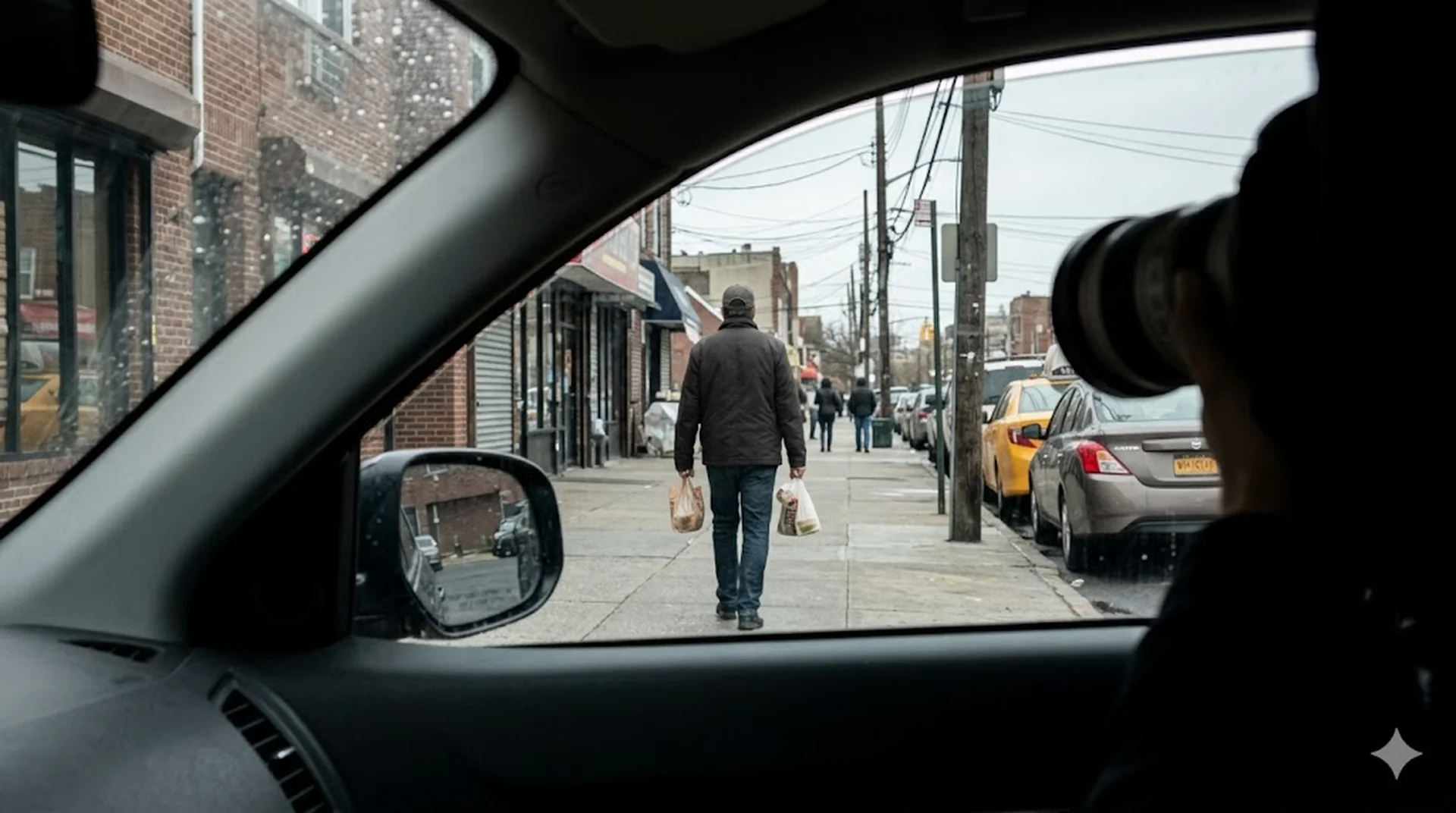
If you filed a personal injury claim in New York, there is a possibility that someone is watching you. Insurance companies and defense attorneys often hire private investigators to record claimants in public, hoping to capture moments they can later use to challenge the seriousness of an injury claim.
That practice is not prohibited simply because it feels invasive. What matters legally is what the defense must do with the footage once litigation is underway. New York addresses that issue through CPLR 3101(i) — a section of the Civil Practice Law and Rules, New York's code governing civil lawsuits.
The rule matters because surveillance footage can be misleading when shown selectively. A short clip of an injured person lifting a bag, bending briefly, or walking without an obvious limp may say little about the pain that followed, the limitations they experience the rest of the day, or how much effort that simple movement actually required.
In This Article
What Sub Rosa Surveillance Means in New York Injury Cases
"Sub rosa" surveillance refers to covert observation and recording conducted without the subject's knowledge. In personal injury litigation, it usually means a private investigator hired by the defense or an insurance carrier records a claimant in public places such as sidewalks, parking lots, stores, or near the claimant's home.
The goal is straightforward: find footage that appears inconsistent with the plaintiff's (injured person) claimed injuries. Investigators may try to capture a person carrying groceries, playing with a child, getting in and out of a car, or completing some household tasks. The defense may then use that recording to argue that the plaintiff is exaggerating pain, limitations, or disability.
The problem is that a short clip rarely tells the full story. Someone living with chronic pain can have brief periods of movement followed by significant discomfort. A video fragment may omit everything that happened before and after the recorded moment. That is why disclosure rules matter so much in this setting.
Key point: The real danger is not just that surveillance exists. It is that selected excerpts can be used out of context unless the plaintiff receives the complete record.
How CPLR 3101(i) Requires Disclosure of All Surveillance Footage
CPLR 3101(i) governs disclosure of surveillance materials in New York civil litigation. Its basic rule is simple: if the defense has surveillance materials relevant to the case, those materials must be produced to the plaintiff.
That does not mean only the clips the defense plans to play for a jury. The disclosure obligation includes raw footage, edited excerpts, and "outtakes" - the portions the defense may prefer not to highlight. In practical terms, the defense is not allowed to decide that only its favorite moments are discoverable.
This full-production rule exists to prevent surprise and unfair selectivity. If the defense records hours of material but intends to show only thirty seconds, plaintiff's counsel — that is, your attorney — is entitled to inspect the broader record and determine whether the selected clip is misleading, incomplete, or contradicted by the surrounding footage.
What "outtakes" means: Think of an investigator like a filmmaker who records far more than ends up in the final edit. Under CPLR 3101(i), the unused portions are part of the disclosure obligation too.
For plaintiffs, this can be critical. The same surveillance session that contains an isolated clip of normal movement may also show slow movement, hesitation, rest breaks, signs of pain, or other context that supports the claim rather than undermines it.
When Surveillance Footage Must Be Disclosed in New York
Surveillance footage is not necessarily disclosed the moment it is requested. New York follows a timing framework shaped by the Court of Appeals decision in DiMichel v. South Buffalo, which generally permits disclosure after the plaintiff's deposition has been completed.
A deposition is the sworn pre-trial examination in which defense counsel questions the plaintiff about the accident, injuries, treatment, physical restrictions, daily activities, and related topics. Courts have reasoned that delaying disclosure until after that testimony helps preserve the integrity of the deposition while still requiring that the materials eventually be turned over.
The balance is important. If footage had to be disclosed before a deposition, a claimant might tailor testimony to the video. If disclosure were never required, the defense could use surveillance as a one-sided ambush. The post-deposition rule attempts to avoid both problems.
How CPLR 3101(i) Applies to Digital Surveillance Video
Surveillance is no longer limited to old videotapes or camcorder recordings. Modern investigations often involve high-definition digital files captured on professional cameras, mobile devices, and other electronic tools. Those files may exist in multiple versions or formats.
In Vazquez v. New York City Transit Authority (2023), courts applied CPLR 3101(i) to digital surveillance files and reinforced the same principle: the defense must produce complete, unredacted surveillance materials. A partial export, selected clip, or edited presentation is not the same thing as the full underlying file.
That matters because digital evidence is easier to trim, compress, re-save, or selectively produce. The legal standard, however, remains the same. If surveillance exists, the plaintiff is entitled to review the complete materials rather than a curated version chosen by the opposing side.
DiMichel v. South Buffalo
DiMichel is central to the timing rule. It generally supports disclosure of surveillance materials after the plaintiff's deposition, balancing the defense's concern about tailored testimony against the plaintiff's right to avoid unfair surprise.
Vazquez v. New York City Transit Authority
Vazquez reflects the modern application of CPLR 3101(i) to digital surveillance files and reinforces that defendants cannot satisfy the rule with selectively edited video production.
Why CPLR 3101(i) Matters in New York Injury Claims
For an injured person, surveillance can feel intimidating even when the claim is entirely legitimate. A brief recording of standing, walking, bending, or carrying something light may look very different from the day-to-day reality of pain, fatigue, or restricted movement.
CPLR 3101(i) matters because it gives plaintiff's counsel a way to challenge that distortion. When all footage must be disclosed, the attorney can review the full sequence, compare it against testimony and medical proof, and explain the missing context. Sometimes the supposedly damaging footage ends up supporting the plaintiff more than the defense expected.
The rule also promotes fairness in the broader litigation process. Courts recognize that trial should not be shaped by a surprise highlight reel that the plaintiff never had an opportunity to inspect. Full disclosure is what keeps the evidentiary playing field from becoming one-sided.
Practical Tips if You Are Being Watched During an Injury Claim
The most practical advice is also the simplest: be honest and be consistent. Follow your doctors' instructions, do not exaggerate what you can or cannot do, and do not push yourself into activities you have been medically told to avoid simply to prove something to yourself or others.
It is also important to understand that public places offer very little privacy from this type of investigation. Parking lots, sidewalks, driveways visible from public vantage points, store entrances, and similar areas are common surveillance locations. There is often little one can do to stop someone from surveilling you in public.
Good days and bad days are normal in many injury cases. A moment of movement does not automatically destroy a claim. What matters most is whether your description of your condition remains truthful, measured, and consistent with the medical evidence.
Practical takeaway: You do not need to live in fear of surveillance, but you should assume that public activity can be observed and discuss any concerns with your attorney early.
How Personal Injury Lawyers Use CPLR 3101(i) Strategically
Obtaining the full surveillance record is not just defensive. It can also become a strategic opportunity. Once counsel receives the complete materials, they can examine whether the edited clips fairly represent the overall recording, whether metadata suggests alteration, and whether there are unexplained gaps in the production.
A fuller review may reveal that an apparently damaging clip is surrounded by footage showing slow movement, visible discomfort, repeated rest periods, or other evidence consistent with injury. In that sense, complete disclosure can convert surveillance from a defense weapon into a source of plaintiff-side context.
Experienced personal injury attorneys also uses this rule to keep litigation honest. If the duration of a surveillance effort does not match the files produced, if exports appear altered, or if outtakes are missing, those inconsistencies can become important discovery issues in their own right. Attorneys may also examine the file's metadata — the hidden technical data embedded in every digital video recording that shows when the file was created, modified, and how long the original recording actually ran — to verify whether the production is complete.
Bottom line: CPLR 3101(i) is not merely about seeing what the defense has. It is about forcing full transparency so surveillance can be tested, contextualized, and challenged fairly.
What CPLR 3101(i) Means for New York Injury Plaintiffs
Surveillance is a routine part of many New York personal injury cases, and insurers invest in it because a carefully chosen clip can influence negotiations or trial strategy. But New York law does not permit that footage to remain a one-sided secret.
CPLR 3101(i) requires disclosure of the complete surveillance record, including outtakes, while the timing framework associated with DiMichel usually postpones production until after the plaintiff's deposition. Modern decisions such as Vazquez show that the same full-disclosure principle applies in the digital era as well.
For injured people, the practical lesson is clear: surveillance may exist, but it does not automatically control the case. What matters is whether your attorney receives the full record and knows how to use the law to expose incomplete or misleading presentation of the facts.
GET A FREE CASE REVIEW NOWFAQ: CPLR 3101(i) and Surveillance Footage Disclosure
Sub rosa surveillance is covert observation and video recording performed without the subject's knowledge. In personal injury litigation, it usually involves a private investigator hired by the defense to record a claimant in public places in hopes of capturing activity that can be used to challenge the injury claim.
Generally, yes. Investigators may observe and record people in public places in New York. The important legal protection for plaintiffs is not a ban on surveillance itself, but the rule requiring disclosure of surveillance materials during litigation so the footage can be reviewed fairly.
Usually yes. CPLR 3101(i) is aimed at full disclosure of surveillance materials, not just the parts the defense finds most useful. That typically includes raw footage, edited clips, and outtakes, so plaintiff's counsel can inspect the broader context of what was recorded.
Under the framework associated with DiMichel v. South Buffalo Ry. Co., disclosure generally occurs after the plaintiff's deposition. That timing is meant to preserve the integrity of sworn testimony while still preventing unfair surprise later in the case. The deposition takes place during the discovery phase of your lawsuit — the pre-trial period when both sides exchange information, evidence, and testimony before the case goes to a jury.
If the production appears partial, redacted, or selectively edited, plaintiff's counsel can challenge whether the defense has complied with CPLR 3101(i). The whole point of the rule is to prevent a misleading, one-sided presentation of the surveillance record.