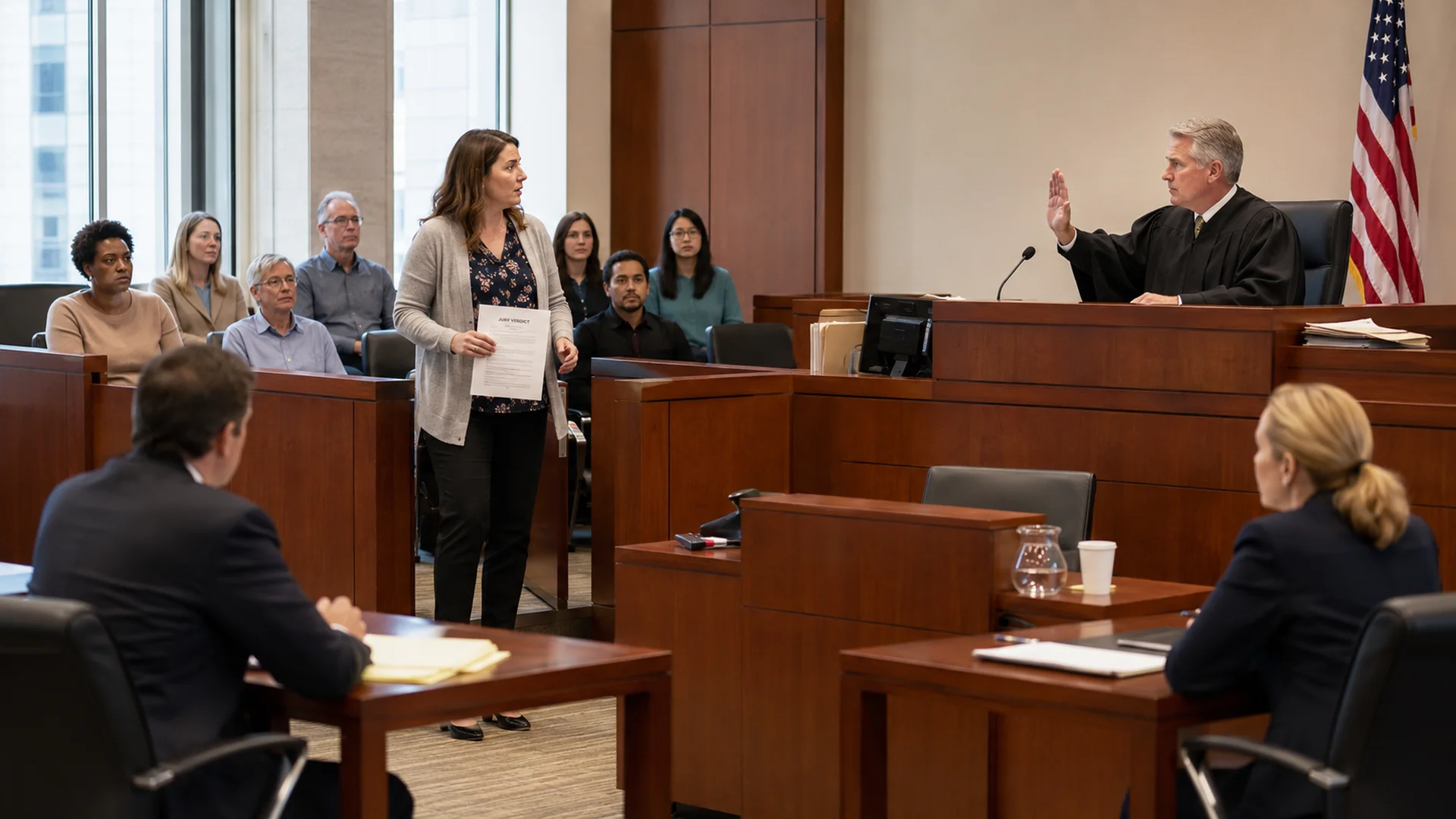
CPLR § 4404: The Trial Court’s Power to Override a Verdict
New York Civil Practice Law and Rules (CPLR) § 4404 is the statute that gives trial judges the authority to modify, vacate, or completely throw out a jury’s verdict or a judge’s bench decision before anyone ever files an appeal. It operates entirely within the trial courtroom, after the verdict has been delivered but before the case moves up to the appellate division.
CPLR § 4404 is the final safety valve inside the trial court. It allows any party to argue that the result was so wrong that the judge needs to step in right now to fix it. That power cuts in both directions: a defendant can use it to attack a plaintiff’s verdict, and a plaintiff can use it to challenge a defense verdict or a damages award that does not come close to reflecting the actual harm.
The statute creates two separate frameworks. Under CPLR § 4404(a), which governs cases decided by a jury, a court may set aside the verdict or any judgment entered on it and direct that judgment be entered in favor of a party entitled to judgment as a matter of law. This is the JNOV (judgment notwithstanding the verdict), the legal term for a judge overriding the jury’s decision outright. Alternatively, the court may order a new trial where the verdict is contrary to the weight of the evidence, in the interest of justice, or where the jury could not reach agreement after being kept together for as long as the court deemed reasonable. Under CPLR § 4404(b), which governs cases decided by a judge alone, the court may set aside its own decision, make new findings of fact or conclusions of law, take additional testimony, render a new decision, and direct entry of judgment, or order a new trial on any cause of action or separable issue.
In This Article
Why Post-Trial Motions Are Weaponized by Defendants
When a plaintiff wins a major financial verdict, defense insurance companies use CPLR § 4404 not primarily to win the motion, but to stall the payout. A post-trial motion freezes enforcement of the judgment while the court considers it, forcing the injured victim to wait months or longer for their money while medical bills accumulate and financial pressure intensifies.
Insurance lawyers use the threat of a CPLR § 4404 motion, specifically the threat of having the verdict thrown out or slashed, to frighten plaintiffs into accepting a heavily discounted post-trial settlement rather than risking a protracted fight. The defense knows that a plaintiff facing mounting debt, ongoing medical treatment, and the prospect of years of additional litigation is a plaintiff who might settle for far less than the jury awarded.
Jury Trials vs. Bench Trials
CPLR § 4404(a): The Jury Trial
A JNOV requires the defense to show that there is simply no valid line of reasoning and permissible inferences which could possibly lead rational persons to the conclusion reached by the jury on the basis of the evidence presented at trial. That is an extraordinarily high bar. It exists specifically to protect a plaintiff’s constitutional right to have the jury’s finding respected. Courts do not override a jury verdict merely because the judge would have decided differently.
A motion for a new trial based on the weight of the evidence sets a lower bar, but still demands far more than a losing party’s disagreement with the outcome. The verdict must be so out of step with the proof that justice cannot tolerate it standing. A difference of opinion between the defense and the jury is not enough.
CPLR § 4404(b): The Bench Trial
When a case is decided by a judge alone, the post-trial landscape is far more fluid. There is no jury verdict to protect. The same judge who decided the case can revisit their own factual findings, take entirely new testimony, reach a different legal conclusion, and issue a completely new decision. That flexibility cuts both ways. A losing plaintiff has a more direct path to correcting a flawed bench decision because the protection the constitutional jury-trial right affords simply does not apply. But there is also no verdict standing between the injured party and a judge who has second thoughts about the decision just rendered.
How Plaintiffs Fight to Protect a Winning Verdict
Defeating the JNOV Argument
One of the defense’s primary CPLR § 4404 arguments after a plaintiff verdict is that the plaintiff failed to prove a threshold element of the negligence claim. In a premises liability case, for example, the defense may argue that the plaintiff never established prior written notice of the hazardous condition. In a medical malpractice or accident case, the argument is often that no causal link existed between the defendant’s conduct and the plaintiff’s injuries. The defense frames this as a JNOV motion, arguing that as a matter of law the plaintiff never had a viable case.
Defeating this requires the plaintiff’s attorney to demonstrate, methodically and with specific citations to the trial record, that testimony, physical evidence, and reasonable inferences fully supported every element the jury found. The standard is not whether some evidence supported the verdict. It is whether a complete evidentiary basis existed for it. A plaintiff who can point to multiple independent strands of proof tying each element together presents the defense with an argument it cannot win under the JNOV standard.
Surviving the Threat of Remittitur
Remittitur is the court’s power to reduce a jury’s damages award when that award deviates materially from what would be reasonable compensation. The standard comes from CPLR § 5501(c), which governs appellate review of damages, but whose “deviates materially” language trial courts have adopted when ruling on CPLR § 4404 motions.
Fighting remittitur means building a documented record before and during trial: expert medical testimony establishing the permanence and severity of the injuries, life care planning evidence quantifying long-term impact, and a clear presentation of how the plaintiff’s daily existence has been permanently altered. A plaintiff whose trial record is thin on those details is the most vulnerable to having a large award cut. The defense looks for that gap. A richly documented record of suffering, lost function, and permanent limitation gives the court a concrete basis for concluding that the jury’s number, however large it appears in the abstract, does not deviate materially from reasonable compensation for what the evidence showed.
How a Plaintiff Rescues a Case After a Loss
Fixing Inconsistent Verdict Sheets
Juries frequently return logically contradictory answers on verdict sheets. A jury might find a defendant negligent while simultaneously finding that the negligence was not a proximate cause of the accident, or apportion fault inconsistently across multiple defendants. When jury answers are so logically incompatible that they cannot be reconciled under any reading of the evidence, New York courts treat them as “inextricably intertwined,” meaning neither finding can stand independently.
A plaintiff who loses due to an internally contradictory verdict can use CPLR § 4404 to demand a new trial on the ground that the jury’s answers reflect confusion, improper compromise, or a fundamental breakdown in deliberation rather than a legitimate finding of fact. The argument is not that the jury decided wrongly. It is that the verdict sheet demonstrates the jury never actually reached a coherent decision at all.
Fighting a Lowball Award Through Additur
Additur is the plaintiff-side counterpart to remittitur. It is the court’s power to increase a damages award the jury set at an unconscionably low level. When a jury finds liability but awards nominal damages or nothing at all for a severe, permanent, life-altering injury, the plaintiff’s attorney uses CPLR § 4404 to argue that the award is so inadequate it deviates materially from reasonable compensation.
A successful additur motion either forces the defendant to accept an increased award or results in a new trial on damages alone, giving the plaintiff a second opportunity to present the full scope of the injuries to a new jury. The liability finding from the first trial remains intact. The new jury decides only what those proven injuries are worth.
Demanding a New Trial in the Interest of Justice
When a defense verdict results not from the evidence but from conduct that prevented the jury from deciding the case fairly, CPLR § 4404(a) provides the broadest ground available: a new trial in the interest of justice. Sustained misconduct by defense counsel during summation, introduction of evidence the court had already excluded, incorrect jury instructions that misstated the applicable legal standard, or evidence concealed during discovery that surfaced only after trial can each support this argument.
This is not a catch-all for disappointment with the outcome. The plaintiff must point to specific, identifiable events during the trial that were not just harmful but fundamentally incompatible with a fair proceeding. Courts evaluate whether the complained-of conduct actually prejudiced the plaintiff’s ability to present a complete case to an unbiased jury.
The 15-Day Clock
CPLR § 4405, the companion rule that controls when a CPLR § 4404 motion must be filed, mandates that the motion be made within 15 days after the verdict in a jury trial, after the decision in a bench trial, or after the court has already ruled on a prior CPLR § 4404 motion.
Missing this window by a single day strips the trial court of the authority to hear the motion at all. For a plaintiff’s attorney, failing to file within 15 days when a verdict requires post-trial correction, whether to challenge a defense verdict, contest an inadequate damages award, or preserve arguments for appeal, constitutes legal malpractice. There is no extension, no excusable neglect exception that courts have applied with any consistency, and no mechanism for late filing once the deadline has passed. Every strategic decision about whether and how to use CPLR § 4404 must be made and executed within that window.
Sternberg Injury Law Firm
Sternberg Injury Law Firm PC represents injured individuals at every stage of litigation, including the high-stakes post-trial phase where insurance companies mount their most aggressive efforts to unwind a jury’s verdict. Our team prepares every case from the first day of intake with post-trial defense in mind, building the medical record, damages documentation, and trial proof necessary to withstand a remittitur attack, and moves immediately after any verdict, winning or losing, to protect the client’s position within the 15-day window CPLR § 4405 demands.
We offer free consultations to all and can be reached by phone, text, or email. Our team can converse in many different languages and can come to your location as necessary.
CPLR § 4404: Frequently Asked Questions
A pending CPLR § 4404 motion pauses enforcement of the judgment. The insurer owes nothing until the motion is resolved, and the freeze continues through any subsequent appeal. An attorney can explore litigation financing or structured arrangements to cover that gap without forcing a discounted settlement.
Generally, no. A CPLR § 4404 ruling is not a final judgment and is not immediately appealable as of right. The losing party must wait for a final judgment to be entered before going to the Appellate Division, meaning the defense can re-raise the same arguments even after losing the post-trial motion. The opposition record built at the trial court level becomes equally critical for that later fight.