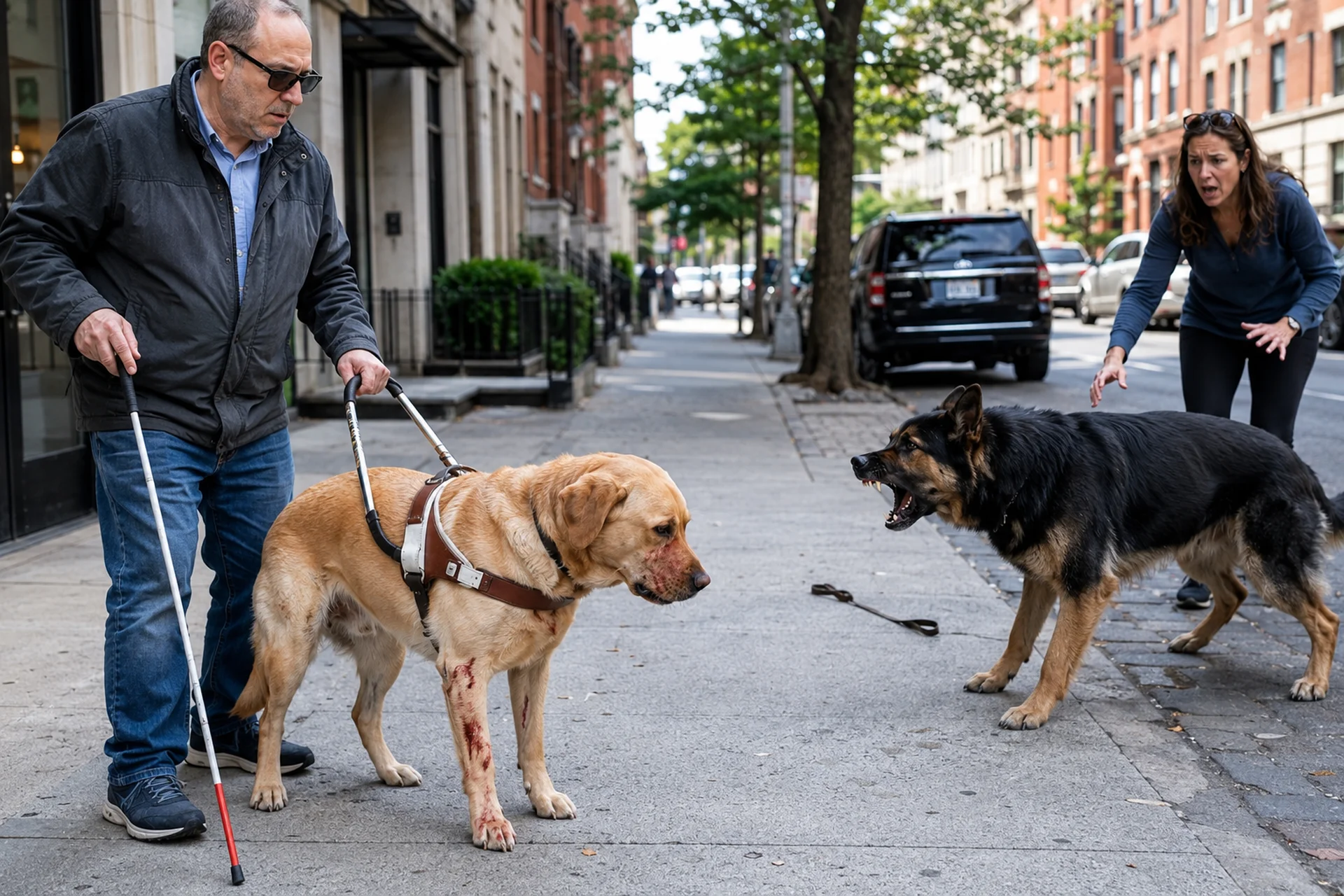
Lawsuit for Injured Pet is only Possible for a Service Dog
When a guide, hearing, or service dog is attacked by another dog, the disabled individual who depends on that dog stands to lose far more than the cost of a veterinary bill. Depending on the severity of the attack, the dog may require weeks of medical recovery, extensive retraining, or in serious cases permanent replacement, each of which can strip away the independence, safety, and mobility the working dog provides. New York law recognizes this reality and General Obligations Law § 11-107 creates a dedicated statutory right for disabled individuals to recover civil damages when their guide, hearing, or service dog is injured due to the negligence of another dog's owner or custodian in handling that dog.
GOB § 11-107 exists because ordinary property damage law falls far short of capturing what a disabled person loses when their working dog is injured or incapacitated. A guide dog for a blind individual is not replaceable the way a piece of furniture is. A hearing dog attuned to a specific person's home and life cannot be swapped out overnight. A service dog trained for a person with physical or psychiatric disabilities may have taken years to certify and cost tens of thousands of dollars. GOB § 11-107 responds to that reality by authorizing a category of recovery that reflects what the disabled handler actually stands to lose.
In This Article
When GOB § 11-107 Applies
The Injured Dog Must Be a Guide, Hearing, or Service Dog
The statute's protections are reserved for trained working dogs. Guide dogs assist visually impaired individuals with navigation and spatial awareness. Hearing dogs alert deaf or hard-of-hearing individuals to critical sounds. Service dogs are trained to perform specific tasks for individuals with physical or psychiatric disabilities. A standard companion dog or household pet does not qualify under this statute.
Another Dog Must Have Caused the Injury
GOB § 11-107 specifically addresses injuries caused by another dog. The liable party is the owner or custodian of the non-guide, hearing, or service dog that caused the injury. Injuries caused directly by a person, a vehicle, a falling object, or any other hazard fall outside this statute's scope, though separate legal avenues may support a claim in those circumstances.
How Liability Is Determined
Negligence Principles
Liability under GOB § 11-107 is grounded in regular negligence. The plaintiff must establish that the owner or custodian of the attacking dog failed to exercise reasonable care in controlling their dog and that this failure caused the injury to the service dog. The statute does not impose strict liability without regard to the other owner's conduct. What it does is provide a dedicated civil cause of action specifically calibrated to the disabled handler's circumstances, separate from the general negligence framework that would otherwise apply.
New York separately recognizes strict liability for dog owners who had prior knowledge of their dog's vicious propensities under Agriculture and Markets Law § 123. GOB § 11-107 is a distinct and additional basis for recovery and does not displace that separate right.
Evidence That May Be Used
Establishing negligence in a GOB § 11-107 claim typically draws on some combination of the following:
- Witness statements from bystanders or the disabled handler describing how the attacking dog was being controlled at the time of the incident
- Animal control reports documenting the attack and any prior complaints involving the attacking dog
- Veterinary records establishing the nature, severity, and cause of the service dog's injuries
- Photographs and video footage of the attack or its immediate aftermath
Compensation Recoverable Under a GOB § 11-107 Claim
The statute identifies recoverable damages using the phrase "including but not limited to," signaling that the list is illustrative, not exhaustive. The following categories represent the core of what a GOB § 11-107 claim can recover.
Veterinary Expenses
Emergency care, surgery, medication, and rehabilitation costs are recoverable economic damages. In a serious attack, these expenses can be substantial, particularly when surgical intervention or extended rehabilitation is required before the dog can return to working status.
Retraining Costs
An attack can leave a working service dog physically injured, behaviorally traumatized, or diminished in its working capacity even after physical recovery. When retraining is necessary to restore the dog to its pre-attack function, the cost of that retraining is expressly recoverable. The need for retraining is not a concession that the dog is permanently impaired; it is a recognition of the real work required to restore a highly trained dog after a violent incident.
Replacement Costs
When retraining is not possible or is insufficient to restore the dog's working capacity, the cost of obtaining a replacement is recoverable. This is frequently one of the most significant elements of damages in a serious case. Trained guide, hearing, and service dogs can cost tens of thousands of dollars and take months or years to acquire and certify. The timeline alone can leave a disabled individual without their primary means of independence for an extended period, and the financial burden of securing a qualified replacement falls squarely within what the statute authorizes.
Lost Wages and Mobility-Related Losses
During the retraining or replacement period, a disabled individual may lose income, lose access to transportation or public spaces they relied on their working dog to navigate, or suffer broader functional disruption to daily life. Lost wages and damages due to loss of mobility incurred during this interim period are expressly recoverable under the statute. This element reflects a deliberate legislative choice to treat the attack's full impact on the handler, not just its impact on the dog, as a compensable harm.
Statute of Limitations for GOB § 11-107 Claims
Claims under GOB § 11-107 are subject to the three-year personal injury statute of limitations under CPLR § 214(5), which governs negligence claims for injury to person or property in New York. The clock generally begins to run on the date of the attack. Missing this deadline permanently bars the claim, regardless of how severe the injuries were, how thoroughly liability can be proven, or how substantial the damages are. Courts do not extend it for equitable reasons once it has passed.
Acting promptly also protects the quality of the evidence that builds the case. Witness recollections fade. Surveillance footage is overwritten or deleted. Animal control records are sometimes purged. A claim filed years after the fact may be technically timely but practically harder to prove. Starting the investigation while those sources are still accessible strengthens every element of the claim.
Lawyer for Injuries to Service Dogs in New York
The personal injury attorneys at Sternberg Injury Law Firm can represent disabled individuals whose guide, hearing, or service dogs have been injured or incapacitated as a result of another dog owner's negligence. Our attorneys pursue the comprehensive recovery the statute authorizes, including the damages that are most easily overlooked: the income lost while waiting for a replacement, the mobility stripped away during retraining, and the full cost of restoring a disabled individual's independence. The Sternberg Injury Law Firm offers free consultations and can be reached by phone, text, email, or website submission. Our team speaks various languages and may be able to come to your location when needed.
Frequently Asked Questions About GOB § 11-107
It can be raised, but trained service dogs are trained to remain calm in public, which would undercut most provocation claims. The dog's training history, behavioral records, and witness accounts are the evidence that typically defeats that defense.
No. The statute does not require formal registration or certification. What matters is whether the dog was functioning as a trained guide, hearing, or service dog. Documentation of the dog's training and working role will be central to the claim regardless.