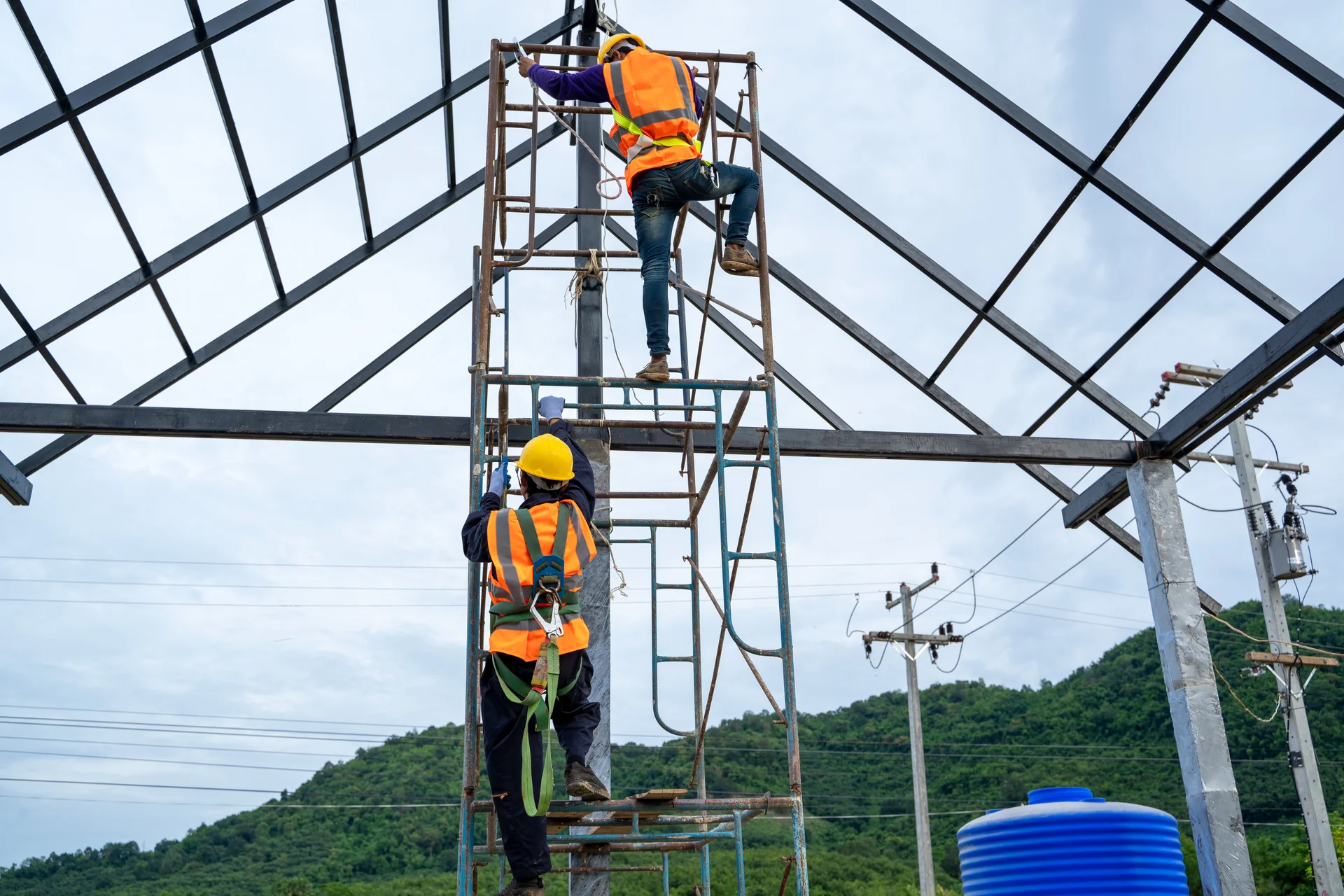
New York Labor Law 240(1), often called the Scaffold Law, is one of the most important laws in New York construction accident cases. It protects workers exposed to serious gravity-related hazards while performing covered work on a building or structure. In real cases, that often means falls from a height, unsafe ladders or scaffolds, or injuries caused by objects that should have been secured.
This law matters because it does not work like an ordinary negligence claim. In a standard personal injury case, the injured person usually has to prove that a defendant failed to use reasonable care, and the defense may try to reduce damages through comparative fault. Labor Law 240(1) is different. If a covered worker was hurt because required safety devices were missing or inadequate, owners, contractors, and statutory agents may be liable without the same comparative-fault arguments that usually apply in negligence cases.
The Core Idea of New York Labor Law 240
Labor Law 240(1) requires specific safety devices to give proper protection to workers performing covered construction-related work. The statute is aimed at elevation-related injuries, not every dangerous condition on a jobsite. The key question is usually whether the injury arose from a gravity-related risk that required a protective device and whether that device was missing, failed, or was inadequate for the task.
In This Article
Understanding New York Labor Law 240(1)
Labor Law 240(1) is a worker-protection statute that applies to certain construction-related activities, including the erection, demolition, repairing, altering, painting, cleaning, and pointing of a building or structure. It places a legal duty on owners, contractors, and certain agents to provide devices such as scaffolds, ladders, hoists, slings, hangers, pulleys, braces, ropes, and related equipment so workers have proper protection from elevation-related hazards.
The statute exists because ordinary worksite safety rules did not adequately protect workers facing serious gravity-related dangers. The issue is not just whether the site was unsafe in a general sense. The real question is whether the task created a height-related risk that required one of the safety devices listed in the law.
In most cases, the first questions are straightforward but important:
- Was the injured person a covered worker?
- Was the person engaged in a protected activity?
- Was the defendant an owner, contractor, or statutory agent within the meaning of the law?
- Did the accident arise from a gravity-related risk requiring proper protection?
Who Is Protected and Who May Be Liable
The law protects workers, not the general public. Owners and contractors are frequent defendants, and an entity with enough supervisory authority over the work that led to the accident may also qualify as a statutory agent. That said, liability is not automatic in every case. Coverage, control, project type, and statutory exemptions all matter.
Gravity-Related Risks in New York Construction Accidents
Not every jobsite accident qualifies as a Labor Law 240 claim. The Court of Appeals in Rocovich v. Consolidated Edison Co., explained that the statute is aimed at the special hazards created by elevation differences and the direct effects of gravity, not ordinary construction site dangers. Labor Law 240 is not a catchall safety statute. A trip on debris at ground level or an injury caused by a routine site condition may be actionable under other legal theories, but it does not automatically fall within the Scaffold Law.
Modern cases ask whether the injury was the direct result of a failure to provide adequate protection against a gravity-related risk. That principle was sharpened in Runner v. New York Stock Exchange, where the Court of Appeals explained that liability does not depend only on whether a worker or object literally fell from a height. The real issue is whether gravity acted on a person or object in a way the statute was designed to guard against.
Falling Worker Cases
The most common Labor Law 240 claim involves a worker who falls from a ladder, scaffold, platform, roof edge, or other elevated work area. In those cases, the inquiry usually focuses on whether the worker had a proper device for the assigned task and whether that device was secured, stable, and appropriate for the work being performed. A ladder that shifts, kicks out, slides, collapses, or is placed in a way that does not provide proper protection may support liability under the statute.
This is the type of reasoning reflected in Zimmer v. Chemung County Performing Arts, where the Court of Appeals treated the failure to provide proper safety devices as the critical statutory violation. The case is often cited for the proposition that when a covered worker is injured because adequate elevation protection was not furnished, the responsible defendants may face absolute liability under the statute.
Falling Object Cases
Falling object claims require a more precise analysis. The mere fact that something fell is not enough to make a case. The object generally must have been in the process of being hoisted or secured, or it must have required securing for the task at hand. The question is whether an enumerated safety device should have been used to keep the object from dropping, descending, or shifting under the force of gravity.
The Runner Decision is especially important because it shows that New York Labor Law 240 can apply even where the injury occurs without a classic overhead drop. If an improperly controlled load moves due to gravitational force and injures a worker, the statute may apply because the injury still flows from the elevation differential and the inadequacy of the device meant to control that force.
The Legal Threshold Courts Apply
In practical terms, courts look for a meaningful height differential and a gravity-driven mechanism of injury. The issue is not simply whether the worker was on a construction site, but whether the accident arose from the type of elevation risk that required a statutory safety device.
Why Labor Law 240(1) Is Different From Standard Negligence Claims
A standard negligence case usually asks whether the defendant acted reasonably under the circumstances. That framework often involves notice, foreseeability, comparative fault, and ordinary care. Labor Law 240(1) is narrower in one sense and stronger in another. It does not cover every unsafe condition, but when it applies, the focus is on whether proper elevation protection was provided, not whether the defendant was merely careless in a general sense.
That distinction matters because construction accident liability can mean very different things depending on the legal theory. In an ordinary negligence case, a worker's conduct may significantly affect the outcome. In a Labor Law 240 case, the key proof usually concerns the safety device, the task, the height differential, and whether the statutory violation was a proximate cause of the injury.
| Issue | Standard Negligence Claim | Labor Law 240(1) Claim |
|---|---|---|
| Core question | Did the defendant fail to use reasonable care? | Was proper protection against a gravity-related risk absent or inadequate? |
| Main proof | Notice, breach of duty, foreseeability, and causation | Covered work, elevation hazard, required device, statutory violation, and proximate cause |
| Worker fault | Usually relevant to damage reduction | Often not a damage-reduction defense if the statute was violated and the violation caused the injury |
| Liability framework | Ordinary negligence principles | Statutory, nondelegable duty with absolute liability when the required elements are met |
The Zimmer case remains one of the leading authorities on this point. The case is often cited for the rule that when the statute requires a protective device and a worker is injured because that protection was not properly provided, liability does not turn on whether a jury thinks the owner or contractor acted reasonably in the ordinary negligence sense.
Absolute Liability and the Limits of Comparative Fault
Lawyers often describe Labor Law 240(1) as imposing absolute liability. The easiest way to understand that phrase is to compare it to ordinary comparative negligence rules. In a negligence case governed by CPLR 1411, the plaintiff's own conduct generally reduces damages. Under Labor Law 240(1), that kind of comparative-fault reduction usually does not apply when the injury was caused by the absence or inadequacy of a required safety device.
That does not mean liability is automatic every time a worker is hurt in an elevation-related accident. It means that once a plaintiff proves a statutory violation and proximate cause, the defense usually cannot avoid or reduce liability by arguing that the worker was merely careless. A worker may have been rushing, standing awkwardly, or making an error in judgment, but if proper protection was not provided and that failure helped cause the injury, comparative negligence generally does not reduce recovery under the statute.
Why This Matters in Real Litigation
In ordinary negligence cases, the defense often seeks to shift a percentage of blame to the injured person. In a valid Labor Law 240 claim, that strategy is far less effective because the case turns on whether the worker received proper protection from a gravity-related hazard. That is a major reason New York Labor Law 240 claims carry unusual leverage in serious construction accident litigation.
Defenses to Labor Law 240(1) Claims
Although the Scaffold Law is powerful, liability is not automatic in every case. The Court of Appeals emphasized this in Blake v. Neighborhood Housing Services of New York. The Blake case is important because it rejects the idea that every ladder-fall creates liability by itself. A plaintiff still must prove both a statutory violation and a causal connection between that violation and the injury.
Sole Proximate Cause
The principal defense is that the worker was the sole proximate cause of the accident. In practice, that means the defense argues that adequate safety devices were available, the worker knew they were expected to be used, and the accident happened only because the worker unreasonably chose not to use them or misused them. If that showing is made, liability may be defeated because the statutory violation is no longer a proximate cause of the accident.
Recalcitrant Worker Doctrine
Closely related is the recalcitrant worker concept. The doctrine does not apply just because a worker made a mistake. It usually requires proof that the worker was given an appropriate safety device, was told to use it, and refused without a good reason. Simple carelessness is not enough. The refusal must break the link between any statutory violation and the injury.
Coverage and Statutory Limits
Defendants also challenge whether the work was covered, whether the accident involved a qualifying elevation differential, and whether the defendant falls within the class of parties who may be liable. Some cases fail because the accident involved an ordinary hazard rather than a gravity-related one, echoing the distinction drawn in Rocovich. Other cases fail because the injured person was not engaged in one of the statute's protected activities. There is also a limited homeowner exemption for certain owners of one- and two-family dwellings who do not direct or control the work.
What Blake Means
Blake teaches that Labor Law 240 is not automatic coverage for every construction injury. A plaintiff still has to connect the accident to an actual statutory violation. But if the failure to provide proper protection contributed to the accident, ordinary worker fault usually does not reduce liability the way it would in a standard negligence case.
Common Scenarios Where Labor Law 240(1) Applies
The following examples show how courts and attorneys typically analyze Scaffold Law claims. The facts always matter, but these scenarios highlight patterns that come up again and again in real cases.
Worker Falling From an Unsecured Ladder
A taper is instructed to patch ceiling joints while standing on an A-frame ladder in a room with unfinished flooring. The ladder is not tied off, no second worker is assigned to steady it, and the worker must lean laterally to reach the work area. As the worker shifts to continue overhead work, the ladder skids and the worker falls to the floor, suffering fractures and a shoulder tear.
That fact pattern often supports liability because the task required elevation and the provided device did not furnish proper protection. The issue is not whether the worker should have been more careful while standing on the ladder. The issue is whether the ladder setup was adequate for the assigned work. That is why ladder cases are frequently analyzed through the logic reflected in Zimmer and Blake.
Scaffold Collapse or Failure of Planking and Guarding
A masonry worker is performing facade restoration from a pipe scaffold several stories above grade. The scaffold lacks adequate planking in the area where the worker is assigned, cross-bracing has been altered, and no proper tie-in or fall arrest system is in place for the configuration being used. During the shift, a section of the working platform gives way, and the worker drops through the scaffold level, sustaining multiple orthopedic injuries.
In that scenario, liability analysis centers on the scaffold as the very device the statute is meant to regulate. If the scaffold was not erected or maintained to provide proper protection, Labor Law 240 is triggered because the injury is a direct consequence of an elevation-related failure.
Worker Injured by a Falling or Uncontrolled Load
A crew is lowering a heavy reel of cable from an upper level using a rope system. The load is not adequately secured, no suitable hoisting or braking device is used, and the workers below are told to control descent by hand tension alone. The reel suddenly accelerates under its own weight, pulling a worker into a steel beam and crushing the worker's hands and torso.
That type of case closely tracks the reasoning in Runner. Even if the worker does not fall and the object does not drop from a dramatic overhead height, the injury may still arise from the force of gravity acting on a load that should have been properly secured or controlled with an appropriate device.
Safety Devices and Legal Responsibility Under the Scaffold Law
In actual litigation, liability is rarely evaluated in the abstract. These cases are highly fact-specific. Lawyers examine what the worker was doing, what device was supplied, whether the device was secured, whether it fit the task, who controlled the work, and whether another protective measure should have been used. The details of how the job was being performed often matter as much as the device itself.
Evidence that commonly matters in Labor Law 240 cases includes:
- Photographs and video of the ladder, scaffold, or load
- Incident reports, site logs, and superintendent notes
- Contracts and subcontracts identifying project roles
- Deposition testimony from the worker, foreman, and safety personnel
- Toolbox talks, job hazard analyses, and fall protection policies
- Measurements showing the height differential and work location
- Expert analysis on whether the device used provided proper protection for the assigned task
This is one of the clearest ways Labor Law 240 cases differ from ordinary premises or negligence claims. The issue is not just whether the site was unsafe in a general sense. The real question is whether a specific gravity hazard required a specific protective measure and whether the defendants with statutory responsibility failed to provide it. That is why experienced personal injury counsel often focus early on preserving physical evidence, identifying the site safety chain of command, and securing testimony before the defense reframes the event as simple worker error.
How These Cases Are Really Evaluated
In serious construction accident litigation, the decisive questions are usually practical: What safety device should have been there? Was it properly placed and secured? Who had the authority to require it? Did the task create a foreseeable gravity risk? The answers to those questions often determine whether a Labor Law 240 claim succeeds on summary judgment or becomes a contested trial issue.