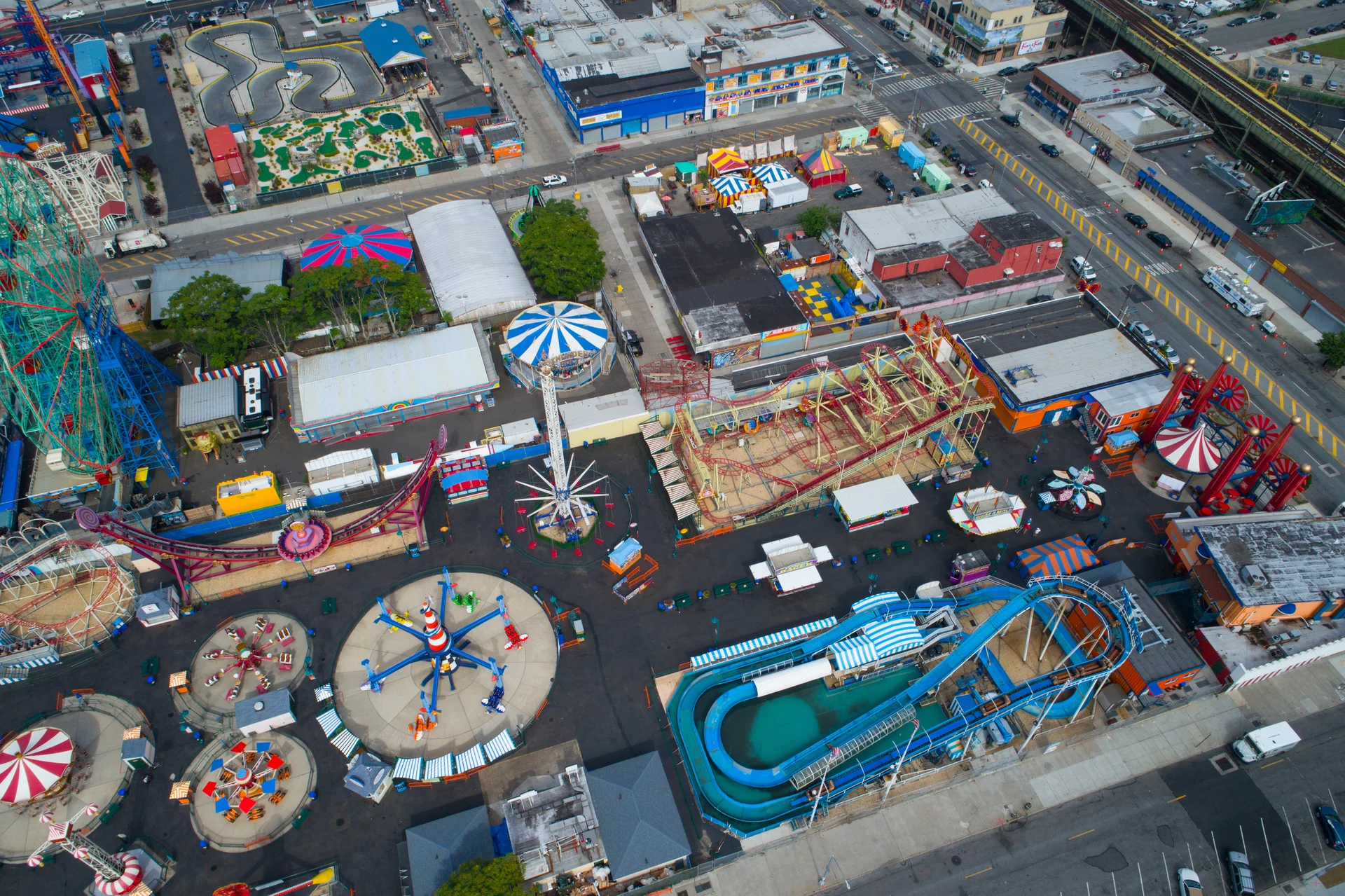
Amusement rides operate in a regulated environment in New York. The state imposes specific inspection, permitting, insurance, and reporting requirements on every operator and owner who makes an amusement device available to the public. When those standards are not met and a rider or bystander is injured as a result, the law provides a basis for recovery under New York Labor Law (LAB) § 870-C and the companion provisions of Article 27.
In This Article
New York Labor Law § 870-C and Who it Protects
Article 27 defines "amusement device" broadly to include any mechanically or electrically powered ride or attraction made available to the public, whether or not it involves a fee. That definition encompasses roller coasters, water slides, go-karts, ferris wheels, spinning rides, bumper cars, inflatable attractions, and similar rides. The statute is meant to include temporary equipment assembled for a single event. When dealing with an injury from a ride, the main issue is whether the device is mechanically or electrically powered and made available to the public in a way that falls within Article 27's regulatory requirements.
The law protects riders, bystanders, and members of the public who may be harmed during the operation, maintenance, or inspection of an amusement device. A rider who boards a roller coaster and is ejected due to a mechanical failure is squarely within the protected class. So is a bystander standing near a ride's exit who is struck when a restraint malfunctions and a car overruns its brake zone. A maintenance worker injured during servicing of a covered device is also within the protections Article 27 was designed to provide.
In practice, the kinds of injuries that arise from violations of the amusement ride statutes include fractures and other orthopedic injuries from sudden jerks or drops on improperly maintained rides, head and spinal trauma from rides that were not designed or inspected to prevent violent movement, drowning or near-drowning incidents at water parks where slides or attractions lack required safety measures, and crush or entrapment injuries caused by defective restraint systems. These are not fringe scenarios. They reflect the real consequences of operating amusement rides without meeting the legal requirements Article 27 imposes.
The Amusement Ride Safety Framework Under New York Law
LAB § 870-C does not stand alone. Four companion provisions define what safe amusement ride operation looks like under New York law, and together they establish the full legal standard that operators and owners must meet before opening a ride to the public.
LAB § 870-E (Inspections) requires that every amusement device be inspected by the Commissioner of Labor or an authorized representative and issued a valid permit before it is made available for public use. A ride that has not passed inspection and received its permit is not authorized to operate. For an injured person, that fact is significant. If the ride that caused your injury was operating without a valid permit, the operator was in violation of New York law before the first member of the public ever set foot on it. That is not a technical deficiency. It means the most basic safety checkpoint the law requires was never cleared.
LAB § 870-G (Reports of Injuries) mandates that when a "serious injury," as that term is defined under Article 27, occurs on or because of an amusement device, the operator must report the incident to the Commissioner by the next business day. More critically, the ride must also be shut down immediately following a serious injury and may not resume operation until it has been inspected and cleared. An operator who fails to report a serious injury, or who reopens a ride before it has been cleared, is compounding the original violation. From an injured person's perspective, evidence that a ride was kept open after a prior serious incident, or that the operator concealed an injury from the Commissioner, bears directly on the operator's awareness that the ride posed a danger.
LAB § 870-F (Liability Insurance) requires that every owner of an amusement device covered under Article 27 maintain liability insurance of at least one million dollars per occurrence before the device may be permitted to operate. This requirement exists to ensure that people injured on covered rides have a real source of financial recovery available to them. The practical significance for an injured person is straightforward: a properly insured ride operator has the financial backing to compensate someone who was hurt because their ride was unsafe. If an owner was operating without the required coverage, that is itself a violation of Article 27, and it may complicate recovery but does not eliminate an injured person's right to pursue a claim.
LAB § 870-K (Criminal Penalties) makes clear how seriously New York treats willful violations of Article 27. Under that provision, a willful violation of the Article that results in physical injury constitutes a Class A misdemeanor. A willful violation that causes serious physical injury or death can rise to a Class E felony. These are criminal consequences imposed on people who knowingly disregard the safety requirements Article 27 imposes. In the civil context, evidence that an operator's conduct was willful rather than merely careless can be relevant to the broader evaluation of their culpability. Criminal exposure also reflects the legislature's judgment that amusement ride safety is not a matter of discretion for the operator. These are obligations, not suggestions.
A ride that was not inspected, not permitted, and not properly insured was already in multiple violations of New York law before anyone was hurt. Those violations are relevant to a civil injury claim regardless of whether criminal charges are ever filed.
Amusement Ride Liability Under New York Law and Regulatory Violations
When a ride operator or owner violates LAB § 870-C, § 870-E, § 870-G, § 870-F, or § 870-K, that violation does not by itself guarantee a successful injury claim. What it does is establish that the responsible party failed to meet a legal standard that New York law imposed on them specifically to prevent harm to people in your position.
The legal principle at work is sometimes called "negligence per se." Under New York law, when a statute is designed to protect people from a defined type of harm, and a someone suffers exactly that harm because the statute was violated, the violation itself can satisfy the breach of duty element of a negligence claim. Article 27 exists to prevent the harm that results from unsafe amusement device operation, and someone injured because those requirements were violated is in a strong position to argue that the responsible party failed to meet the standard the law imposed on them.
The distinction between violations that directly caused the injury and those that constitute relevant background evidence matters to how a personal injury case is established. A permit failure under § 870-E that allowed an uninspected ride to operate goes to the heart of causation if the defect that caused the injury is one inspection would likely have caught. A reporting failure under § 870-G speaks to the operator's knowledge that the ride was dangerous. Both types of violations are legally significant. Their precise relevance depends on the specific facts of the incident.
Common Operator and Owner Violations in New York Amusement Ride Injury Cases
The range of conduct that can give rise to liability in a New York amusement ride injury case is broad. The following categories are most commonly at issue when an injured person pursues a claim under Article 27:
- Operating a ride that was not inspected, not permitted, or not cleared for public use before the injury occurred
- Operating without the required liability insurance, leaving injured people without a guaranteed source of financial recovery
- Keeping a ride running after a serious injury instead of shutting it down and reporting it, thus continuing to expose the public to a known danger
- Neglecting routine maintenance or failing to address mechanical issues that were known or discoverable through reasonable inspection, leading to a failure during operation
- Failing to properly train ride operators or attendants on safety procedures, restraint systems, and emergency protocols
- Allowing riders to board a device with defective restraints, missing safety equipment, or mechanical components in a state of disrepair
- Failing to take adequate precautions to protect bystanders in the immediate area of a ride's operation
Not every injury on an amusement ride gives rise to a viable claim against the operator or owner. If an injury results entirely from a rider's own decision to behave in a way that the ride's safety systems could not reasonably be designed to address, or from conditions that were genuinely unforeseeable and outside the operator's knowledge or control, the legal analysis is different. The critical questions are what the operator and owner knew, what they should have known, and whether they took the steps the law required them to take in light of that knowledge.
How the Circumstances of an Amusement Ride Injury Affect a Claim in New York
Whether you were a paying rider, a guest who was not charged separately, or a bystander struck by a malfunction, your role at the time of injury shapes what evidence is available to you and how a claim is framed. It does not determine whether the law applies.
Whether the injury was caused by a mechanical failure or by the conduct of a ride operator or attendant matters more to the specifics of how a claim is constructed than to whether a claim exists at all. A mechanical failure on an inspected and properly maintained ride raises different questions than the same failure on a ride that was last inspected two seasons ago and has documented maintenance issues. Operator errors, such as improperly loading riders, failing to confirm that restraints are secured, or running a ride at speeds inconsistent with its design parameters, can establish liability independent of any mechanical defect.
The location of the ride matters in a practical sense. A permanent installation at a major amusement park typically has a longer paper trail: inspection records, maintenance logs, incident reports, staffing records, and operational documentation that can be obtained and analyzed. A temporary ride assembled at a county fair or traveling carnival presents different evidentiary challenges. The operator may be a traveling company, the equipment may have been assembled quickly by a small crew, and the permit and inspection records may be harder to locate. These logistical differences affect the investigation, not the underlying legal rights.
Important New York Cases Under NY LAB § 870-C and Related Authorities
Ortiz v. Splish Splash at Adventureland
Ortiz v. Splish Splash at Adventureland addressed the liability of a New York water park operator for injuries sustained by a rider on one of its attractions. The central question before the court was whether the operator had breached the duty of care it owed to the injured plaintiff under the circumstances of the ride's operation. The court's analysis focused on the relationship between the operator's control over the ride and its responsibility for how that ride was designed to function and how its attendants managed the boarding, operation, and dismounting process. The decision established that an amusement park operator cannot insulate itself from liability for injuries that occur during the ordinary operation of its attractions by pointing to generalized warnings or assumption-of-risk arguments when the plaintiff's injury resulted from a condition or practice within the operator's direct control. For an injured person today, Ortiz stands for the principle that the operator's knowledge of and control over the conditions that produced the injury are central to the liability analysis, and that water parks and similar facilities are held to a meaningful standard of care in how their attractions are run.
Dwaileebee v. Six Flags (Darien Lake)
Dwaileebee v. Six Flags (Darien Lake) arose from an injury sustained at one of New York's major amusement parks and presented the court with questions about the standard of care owed to ride participants and the connection between the operator's conduct and the plaintiff's harm. The court examined what the operator knew about the ride's operational conditions, whether the plaintiff's injury was foreseeable given those conditions, and whether the operator had taken the steps required of a reasonably careful ride operator. The decision reinforced that the duty an amusement park operator owes to its guests is a meaningful one, that foreseeability of harm plays a central role in determining whether the operator is responsible, and that the plaintiff's status as a voluntary participant in a ride does not by itself defeat a negligence claim when the operator's own conduct or omissions contributed to the conditions that caused the injury. For someone who was injured at an amusement park or water park and is evaluating whether to pursue a claim, Dwaileebee is relevant authority on how courts in New York analyze the operator's responsibility for what happens to riders under their control.
What to Do After an Amusement Ride Injury in New York
The steps you take immediately after an amusement ride injury can have real consequences for the strength of a potential legal claim. Evidence disappears quickly, rides are repaired or removed, and operators may take steps to limit their exposure. Acting promptly protects your position.
- Seek medical evaluation right away, even if your injuries do not feel severe at the time. Some injuries, including concussions and spinal trauma, may not produce their full symptom picture immediately. A documented medical evaluation from the day of or the day after the incident creates a contemporaneous record connecting your condition to the event.
- If possible, document the scene and the ride before you leave if you are physically able to do so. Photograph the ride, the area where the injury occurred, any visible mechanical issues, restraint systems, warning signs, and the surrounding environment. If other people witnessed the incident, try to obtain their names and contact information.
- Identify the operator and owner of the ride. At a permanent amusement park, that information is readily available. At a traveling carnival or fair, ask for the name of the ride operator and the company that owns the equipment before you leave. This information can be harder to locate after the fact.
- Request or preserve any records you can access, including any incident report the park or carnival fills out at the scene, your ticket or wristband, and any receipts showing your presence at the facility.
- Do not under any circumstances sign any documents, releases, or statements presented by the facility or its representatives before speaking with an attorney. Those documents can waive rights you do not yet fully understand.
- Consult a New York personal injury attorney as soon as reasonably possible. There are statute of limitations deadlines on personal injury claims in New York. For most claims the general deadline is three years, though the specific deadline that applies depends on the facts of your case. If the injured person is a minor, the statute of limitations is lengthened. Missing the deadline will permanently bar a claim regardless of its merits.
Violations of LAB § 870-C, § 870-E, § 870-G, § 870-F, or § 870-K can support a civil injury claim even when the state's regulatory system has not taken formal enforcement action against the operator or owner. A decision by the Department of Labor not to revoke a permit or assess a fine does not resolve an injured person's right to seek compensation in civil court. Those proceedings operate under different standards and serve different purposes.
Personal Injury Lawyer for Amusement Ride Injuries
The personal injury attorneys at Sternberg Injury Law Firm accept amusement ride injury matters throughout New York. Our team can evaluate the circumstances of your injury, identify the operators and owners responsible for the ride, assess whether violations of the applicable statutes give rise to a viable claim, and pursue the matter on your behalf. We offer free consultations and represent clients across New York State.
NY LAB § 870-C Frequently Asked Questions
Yes, in many cases. If the operator or owner of the ride violated NY LAB § 870-C, § 870-E, § 870-G, § 870-F, or § 870-K in a way that caused or contributed to your injury, those violations can support a negligence claim. Whether your specific circumstances give rise to a viable claim depends on the facts of the incident, who controlled the ride, and the nature and extent of your injuries. An experienced New York personal injury attorney can evaluate those factors.
LAB § 870-C and Article 27 of the New York Labor Law cover a broad range of amusement devices, including mechanical rides, water slides, roller coasters, go-karts, ferris wheels, and similar attractions at both permanent amusement parks and temporary installations such as fairs and carnivals. The statute defines the covered category broadly to reach virtually any mechanically or electrically powered ride or attraction made available to the public.
Yes, significantly. LAB § 870-E requires that every covered amusement device be inspected and issued a permit before it is operated. A ride that was running without a valid permit was in violation of New York law before anyone was injured. That violation is directly relevant to a claim and can demonstrate that the operator bypassed the most basic safety checkpoint the law requires.
Yes. Whether you paid an admission fee does not determine whether you have a legal basis to pursue a claim. A bystander struck by a malfunctioning ride or debris from an unsafe operation is within the class of people Article 27 is designed to protect, just as a rider on the device is. Your role shapes the evidence available to you, not your right to bring a claim.
A regulatory violation establishes that the operator or owner failed to meet a legal standard New York imposed on them. It does not automatically win the case. To prevail in a negligence claim, you must also show that the violation caused or contributed to your injury. The violation is powerful evidence that the responsible party breached the standard of care, but causation must still be established through the specific facts of how and why the injury occurred.