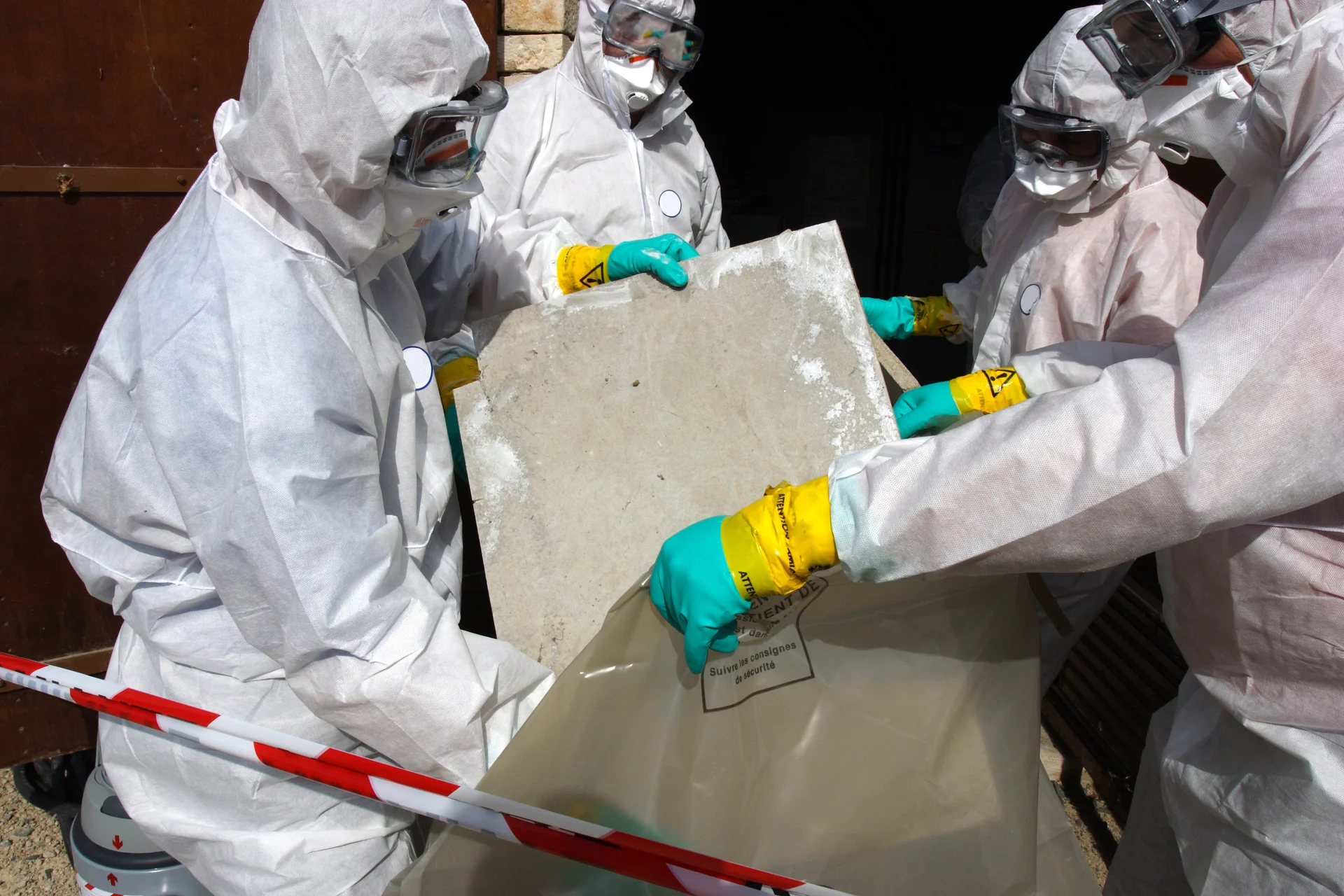
Asbestos is a fibrous mineral once widely used in construction and manufacturing. It was known for its strength, heat resistance, and affordability. When disturbed, it is highly dangerous, releasing microscopic fibers that cause severe illnesses like asbestosis and cancer when ingested or inhaled. Therefore, in New York, contractors and property owners are subject to strict, enforceable duties when handling asbestos. When those duties are breached and an individual suffers harm as a result, the law provides a basis for recovery under New York Labor Law (LAB) § 901
In This Article
New York Labor Law § 901 and Who it Protects
New York Labor Law § 901 is the core statutory provision governing the handling of asbestos. The law applies to anyone who engages in the removal, encapsulation, enclosure, or disturbance of asbestos-containing materials at a worksite or building. That includes general contractors, subcontractors, specialty asbestos abatement firms, and building owners who direct or permit asbestos work on premises under their control.
The statute protects a broad class of people. Workers directly involved in the asbestos project are covered. So are other tradespeople present at the same site who may be exposed to released fibers during nearby asbestos operations. Building occupants, including tenants and employees who remain in a building where asbestos is being disturbed, are within the protected class as well. Bystanders near an affected site, such as individuals who live or work in adjacent properties, can also be harmed when asbestos fibers travel beyond the immediate work area.
The statute also reaches incidental disturbance of asbestos-containing materials during renovation, demolition, and repair work, not only deliberate abatement projects. Any activity that breaks apart, sands, cuts, drills, or otherwise disturbs a material containing asbestos brings the project within the law's requirements.
The Asbestos Compliance Framework Under New York Law
LAB § 901 does not operate in isolation. Three companion authorities define what proper asbestos handling actually looks like in practice. Together, they establish the full legal standard that contractors and building owners are required to meet.
LAB § 902 requires that anyone performing asbestos work in New York be licensed and certified by the state before beginning any project. This is not a formality. An unlicensed contractor handling asbestos is operating outside the law from the moment work begins. For an injured person, the absence of proper licensing is a legal violation that bears directly on whether the contractor should have been doing the work at all. A licensed contractor is one who has demonstrated, at minimum, that they have met the state's requirements for competence in asbestos handling. An unlicensed contractor has not cleared even that threshold.
LAB § 906 mandates specific work practices and safety procedures that must be followed during every covered asbestos project. This includes requirements for physical containment of the work area, advance notification to affected building occupants and regulatory authorities, use of appropriate personal protective equipment, and proper procedures for collecting and disposing of asbestos-containing debris. These are not recommendations or best practices. They are legal obligations, and the failure to meet them has direct consequences when an injury results.
12 NYCRR Part 56 is New York's industrial code governing asbestos handling. It outlines the technical specifics of how covered work must actually be performed: the materials and methods required, training standards, air monitoring requirements, and handling procedures that contractors are expected to follow on every project. Part 56 is the detailed rulebook that gives meaning to the broader statutory obligations. When a contractor or building owner deviates from its requirements, that deviation can be introduced in a civil case as evidence that the responsible party failed to meet the standard of care the law imposed on them.
Violations of 12 NYCRR Part 56 are not merely administrative infractions. Courts have recognized them as evidence of negligence in civil injury cases brought by workers and building occupants who were exposed to asbestos.
Asbestos Exposure Liability Under New York Law and Regulatory Violations
When a contractor or building owner violates LAB § 901, § 902, § 906, or 12 NYCRR Part 56, that violation does not automatically result in a successful injury claim. What it does is establish that the responsible party failed to comply with a legal standard the law imposed on them. In a negligence case, that failure is powerful and often central evidence.
The legal concept at work here is "negligence per se." Under New York law, when a statute is designed to protect a specific class of people from a specific type of harm, and a member of that class suffers exactly that harm because of a violation of the statute, the violation itself can establish the breach of duty element of a negligence claim. LAB § 901 and the statutes and regulations that accompany it exist precisely to prevent the harm caused by improper asbestos handling. A person injured through asbestos exposure resulting from violations of those laws is in a strong position to argue that the defendant failed to meet the standard of care the law required.
The distinction between violations that directly caused the exposure and those that constitute relevant background evidence matters to how a claim is constructed. A contractor who failed to establish the containment barriers required under LAB § 906 and Part 56, and whose failure allowed asbestos fibers to reach the area where the plaintiff was present, has committed a violation that goes directly to causation. A contractor who failed to file the required pre-project notification but whose actual handling procedures were otherwise adequate, presents a different evidentiary picture. Both violations are legally significant. The first is more directly tied to why the exposure happened.
Common Contractor and Property Owner Violations in New York Asbestos Exposure Cases
There are a broad range of actionable conduct under these statutes and regulations. The following categories are most commonly at issue when an injured person brings a claim based on asbestos exposure:
- Performing asbestos work without the license or certification required under LAB § 902, which signals from the outset that the contractor was operating outside the law
- Failing to establish and maintain proper physical containment around the work area, allowing asbestos fibers to reach spaces where workers, tenants, or other occupants were present
- Disturbing asbestos-containing materials without providing the required advance notification to building occupants, managers, or regulatory authorities
- Improper disposal of asbestos-containing waste, including failure to bag, label, or transport materials in the manner required by Part 56
- Failing to supply workers with respiratory protection and personal protective equipment, which puts workers and nearby individuals at risk
- Conducting asbestos work in a shared building without restricting access to the affected area, exposing tradespeople, tenants, or visitors who had no reason to expect asbestos fibers in the air
Not every asbestos exposure situation gives rise to a viable claim against a particular defendant. If the presence of asbestos was genuinely unknown, undisclosed, and undetectable through reasonable inspection, and the party had no means of knowing asbestos-containing materials were present, the analysis is different from a situation where the responsible party knew or should have known about the material and proceeded without the required precautions. The critical question is what the defendant knew, what they should have known, and what the law required them to do in light of that knowledge.
How the Circumstances of Asbestos Exposure Affect a New York Injury Claim
Your relationship with the worksite shapes the legal theory and evidence underlying your claim. A worker employed on the project will often have contemporaneous employment records, co-worker witnesses, and air monitoring data that can be used to establish the nature and duration of the exposure. A tenant or building occupant typically relies on evidence of the project's scope, expert testimony about ambient fiber levels in the building during the relevant period, and documentation of the defendant's failure to contain the work area. The facts you will need to assemble differ. The legal right to hold the responsible party accountable does not.
Whether the exposure was brief or prolonged is relevant to the medical picture, particularly to the likelihood of developing an asbestos-related illness. A single significant exposure event can be sufficient depending on the disease involved. These are questions that medical and scientific experts address based on the specific circumstances of each person's situation. From a legal standpoint, the duration of exposure bears on what damages can be established, not on whether the defendant owed a duty to act safely.
A common defense in incidental disturbance cases is that the contractor was not an asbestos abatement firm and did not consider asbestos removal part of the job. That argument does not hold up under the statute. A plumber whose work requires opening a wall containing asbestos pipe insulation, or a flooring contractor who sands down asbestos-containing tiles during a renovation, is subject to the same licensing, containment, and notification obligations as a contractor engaged in a full removal project. The law imposes those obligations based on what the work involves, not on how the contractor describes what they were hired to do.
New York Cases Under NY LAB § 901 and Related Authorities
Maffei v. Burnham LLC
Maffei v. Burnham addressed the liability of a property owner and contractor for asbestos exposure arising from renovation work at a commercial building. The court's analysis centered on the degree of control the defendants exercised over the way the asbestos-disturbing work was conducted. Maffei established that a party who directs, oversees, or retains control over asbestos work cannot escape liability for the resulting exposure by pointing to the involvement of a subcontractor or arguing that the actual physical work was performed by someone else. Where the defendant had the authority to require compliance with proper handling procedures and failed to exercise it, the court treated that failure as actionable. For an injured person today, Maffei stands for the principle that control over asbestos work carries legal responsibility for how that work is done, and that responsibility cannot be contracted away through the project's organizational structure.
Nemeth v. Brenntag North America
Nemeth v. Brenntag North America, 38 N.Y.3d 301 (2022), is one of the most significant recent decisions from the New York Court of Appeals on causation in asbestos exposure cases. The central question was what evidence is sufficient to establish that a specific defendant's asbestos-containing product caused the plaintiff's illness. The Court of Appeals examined whether the plaintiff's expert testimony adequately connected the defendant's product to the disease, applying the standard that requires a plaintiff to demonstrate that the exposure was a substantial contributing factor to the development of the asbestos-related condition. The decision reinforced that causation in asbestos cases must be established through reliable scientific and medical evidence tied to the specific exposure at issue, not through generalized testimony about asbestos risk. For someone who was exposed to asbestos and later developed mesothelioma, lung cancer, or another asbestos-related illness, Nemeth is governing authority on what their attorney must demonstrate in court to connect the defendant's conduct to the disease. The strength of medical and expert evidence is not a secondary concern. It is central to the claim.
What to Do After Asbestos Exposure in New York
The most important first step is a medical evaluation. Asbestos exposure does not always produce symptoms immediately, and the diseases it causes, including mesothelioma, asbestosis, and asbestos-related lung cancer, can take years or decades to develop. A physician familiar with occupational and environmental exposure can assess your situation, order appropriate testing, and create a documented record that connects your health status to the exposure event.
Beyond medical care, several steps protect the evidentiary value of a potential claim while the evidence is still available:
- Document what you know about the exposure: where it occurred, when, for how long, and what work was being done at the time. Details that seem minor now may be significant later.
- Identify the contractors, building owners, and other parties who controlled the worksite or building at the time of exposure. This information is essential to establishing who may be held responsible.
- Preserve any photographs, employment records, lease agreements, or other documents that establish your presence at the location. If you have records showing you worked or lived at the site during the period of asbestos activity, retain them.
- Do not sign any releases, settlements, or other documents presented by a contractor, building owner, or their insurer before consulting with an attorney. Those documents can waive rights you do not yet fully understand.
- Consult a New York personal injury attorney as soon as reasonably possible. There are statute of limitations on asbestos-related injury claims. For most personal injury claims the deadline is three years, though specific rules apply depending on the nature of the illness and when it was or should have been diagnosed. Missing that deadline can permanently close the claim.
Contact Sternberg Injury Law Firm
Violations of LAB § 901, § 902, § 906, or 12 NYCRR Part 56 can support a civil injury claim even when the regulatory system has not taken formal enforcement action against the responsible party. An agency decision not to impose penalties does not resolve an injured person's right to seek compensation. Those are separate proceedings with different standards and different purposes.
The personal injury attorneys at Sternberg Injury Law Firm welcome asbestos exposure and construction site injury matters in New York. Our team can evaluate the circumstances of your exposure, identify the parties who controlled the work, assess whether violations of the applicable statutes and regulations give rise to a viable claim, and pursue the matter on your behalf. We offer free consultations and handle cases throughout New York State.
NY LAB § 901 Frequently Asked Questions
Yes, in many cases. If a contractor or building owner violated NY LAB § 901, § 902, § 906, or 12 NYCRR Part 56 in a way that caused or contributed to your exposure, those violations can support a negligence claim. Whether your specific circumstances give rise to a viable claim depends on the details of the exposure, who controlled the work, and the illness you developed. An experienced attorney can evaluate those factors.
LAB § 901 covers the removal, encapsulation, enclosure, and disturbance of asbestos-containing materials at worksites and buildings. That includes deliberate abatement projects as well as the incidental disturbance of asbestos-containing materials during renovation, repair, or demolition work. The statute is not limited to projects where asbestos removal was the primary purpose of the work.
Yes. LAB § 902 requires that anyone performing asbestos work in New York be licensed and certified before starting the project. An unlicensed contractor was operating in violation of the law from the outset. That violation is directly relevant to an injury claim and can serve as evidence that the contractor lacked the qualifications the law required before any asbestos work could lawfully begin.
Yes. The statute's protections extend to building occupants and bystanders, not only to workers on the project. Your role determines what evidence is available to you, not whether you have a legal basis to pursue a claim. A tenant or nearby resident who can establish the contractor's failure to contain the work area and link that failure to their exposure is in a comparable legal position to a worker on the site.
A regulatory violation establishes that the responsible party failed to comply with a legal standard. It does not automatically resolve the case in your favor. To prevail in a negligence claim, you must also show that the violation caused or contributed to your exposure and that the exposure caused the illness you are claiming. The violation is powerful evidence of breach, but causation must still be established through medical and scientific proof.