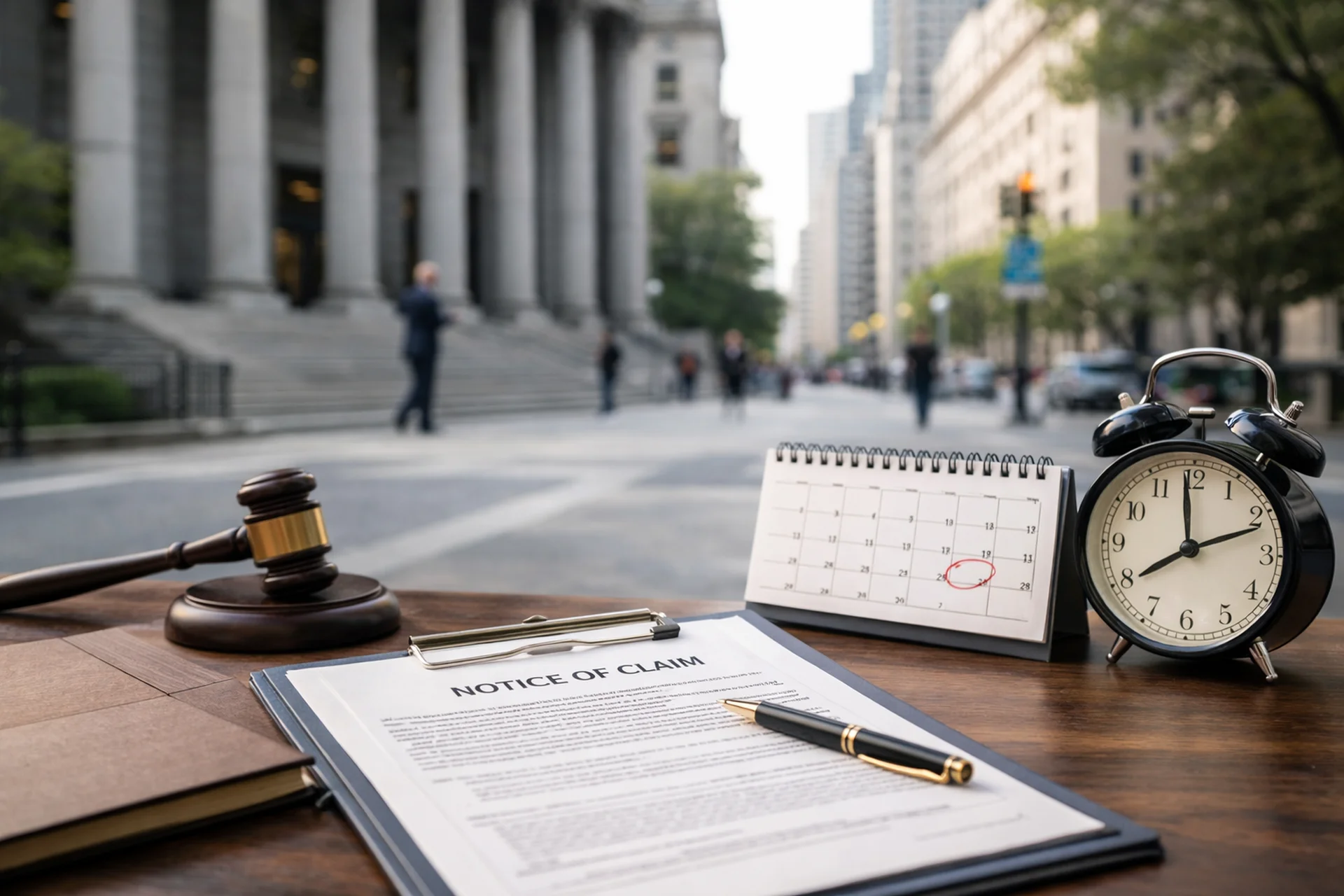
Many people assume that if they're injured due to a government entity's negligence, they can simply hire an attorney, file a lawsuit, and win substantial amounts of money. That assumption is wrong — and it costs people their cases every year. In our experience handling municipal injury claims across New York State, procedural dismissals are among the most preventable outcomes in personal injury law. The rules are strict, the deadlines are real, and they apply before you ever set foot in a courtroom.
Claims against municipalities from a large cities such as Yonkers to a small villages such as Woodridge are governed by a strict procedural framework that has nothing to do with the merits of the injury. Before any lawsuit can be filed, the injured person or their attorney must comply with the Notice of Claim requirement under New York's General Municipal Law Section 50-e. Miss the deadline or make a technical error in service, and even a strong, well-documented claim will probably be thrown out of court.
In This Article
The Notice of Claim: Your First and Most Important Step
A Notice of Claim is a formal written document that must be served on a municipality — whether that's New York City, a county, a school district, or a public authority — before you can sue. Its purpose is to give the government entity early notice of what happened so it can investigate while evidence is still fresh.
Under General Municipal Law Section 50-e, the Notice must identify who is making the claim, when and where the incident occurred, how it happened, and what injuries are being alleged. Courts apply a "substantial compliance" standard — meaning minor technical errors won't automatically sink your claim. But that's a narrow safety net, not a license for sloppy drafting. The municipality must be able to understand the claim well enough to investigate. In practice, this means the location of the accident should be described with a specific address or cross-street, not just a neighborhood. The nature of the defect — a broken sidewalk flag, a missing handrail, a pothole — should be identified clearly. Vague descriptions of location or cause become ammunition for defense attorneys at every stage of litigation.
The 90-day deadline is non-negotiable. The Notice of Claim must be served within 90 days of the date the claim arises — in most injury cases, that is the date of the accident. This deadline is treated as a strict condition precedent to suit, not a flexible guideline. It is one of the most ruthlessly enforced procedural rules in New York personal injury law.
Proper service matters just as much as timing. Claims against New York City must be served on the NYC Comptroller's Office, located at 1 Centre Street, in Manhattan. Claims against the MTA or NYC Transit go to a different office entirely. School districts, public housing authorities, and other entities each have their own designated recipients under the law. This is one of the most common errors we see — a Notice served on the wrong agency, even days after the accident, with perfect content, can be treated as a nullity. The result is the same as if you never filed at all.
The 50-h Hearing: What Happens After You File
Once a Notice of Claim is served, the municipality has the right to conduct a pre-suit examination under General Municipal Law Section 50-h - hence called a "50-h hearing". This is a sworn oral examination — taken under oath, on the record — where the claimant is questioned about how the incident occurred, the injuries sustained, and the medical treatment received. The municipality may also request medical authorizations and, in some cases, an independent medical examination.
From the municipality's perspective, the 50-h hearing is an investigative tool. It lets their attorneys lock in your account of events early, compare your testimony against the Notice of Claim, and begin evaluating liability and damages before any lawsuit is filed.
From your perspective, consistency is critical. Discrepancies between the Notice of Claim and hearing testimony become ammunition in motion practice and at trial. Municipal defense attorneys and insurance defense attorneys are specifically trained to probe for discrepancies or inconsistencies. Failing to appear for a 50-h hearing — or failing to meaningfully participate — can result in dismissal of the claim.
Before your 50-h hearing, you should: review with your attorney your Notice of Claim carefully; have a clear, accurate account of the accident sequence prepared; understand that "I don't know" or "I don't remember" is a perfectly acceptable answer when it's true; and never speculate. You are not expected to know legal theories — but you are expected to tell the truth consistently.
What If You Miss the 90-Day Deadline?
Missing the deadline doesn't automatically end the case, but it fundamentally changes your legal position.
You can apply to the court for permission to serve a late Notice of Claim under General Municipal Law Section 50-e(5). Courts evaluate three factors — and none of them alone is automatically decisive:
- Reasonable excuse — Did you have a credible reason for missing the deadline? (Note: ignorance of the law, on its own, is generally not accepted as a sufficient excuse.)
- Municipal knowledge — Did the government entity learn about the essential facts of your accident within or shortly after the 90-day window — through a police report, an internal incident report, 311 complaints, or otherwise?
- Prejudice to the municipality — Has the delay actually impaired their ability to investigate? Under the Newcomb standard (see below), the burden is on the municipality to show concrete harm, not just the passage of time.
How New York Courts Apply the Standard
The leading case is Matter of Newcomb v. Middle Country, decided by the New York State Court of Appeals in 2016. Before Newcomb, lower courts across the state were applying the three-factor test inconsistently — some treating the absence of a reasonable excuse as automatically fatal, others placing disproportionate weight on municipal knowledge. Newcomb brought clarity. The Court of Appeals held that no single factor is determinative and that the analysis must be genuinely balanced. Most importantly, the Court placed the burden squarely on the municipality to demonstrate actual prejudice from the delay — not theoretical or speculative harm, but concrete impairment to its ability to investigate. Where a municipality cannot point to specific evidence that was lost or unavailable because of the delay, prejudice is not established simply by the passage of time.
That said, Newcomb did not make late Notice applications easy. It made them principled. What it means for claimants is this: if you missed the deadline but the city sent an investigator to the scene, documented the defect, or generated internal records about the incident, you have a stronger argument than the raw delay might suggest. Conversely, if there's no paper trail and no explanation for the gap, Newcomb won't save you.
Matter of Nunez v. Village of Rockville Centre adds an important dimension to the knowledge prong. The question is not simply whether the municipality was aware that an accident occurred, but whether it had timely knowledge of the essential facts that form the basis of the claim — the location, the nature of the condition, and the theory of liability. Generalized awareness is not enough. A municipality that learned from a police report that someone was injured on a public street has not necessarily acquired the kind of knowledge that satisfies this prong, particularly if the specific defect at issue was never identified or documented in that report.
What This Means in Practice
Late Notice applications are genuinely fact-intensive. The same delay that results in granted relief in one case will be denied in another based on how the municipality documented the incident, what records were generated, whether witnesses are still available, and how the claimant explains the gap. Courts do not apply this as a checklist — they weigh the totality of circumstances.
The practical reality is this: even a well-supported late Notice application requires litigation over procedure before you ever reach the merits of the injury. That procedural fight costs time, money, and introduces a layer of uncertainty that simply does not exist when the 90-day deadline is met.
How Municipal Claims Differ From Standard Personal Injury Cases
When your injury involves a private party — a business, a property owner, another driver — you can proceed directly under standard negligence principles. There is no Notice of Claim requirement, no pre-suit examination, and no 90-day window to worry about.
Municipal claims are different from the moment the incident occurs. The procedural requirements apply immediately, and they run parallel to — not after — the process of gathering evidence and evaluating liability. Common scenarios include sidewalk and roadway defects (which usually carry additional prior written notice requirements), injuries on public transportation, accidents at public schools, and incidents arising from municipal maintenance operations.
The underlying negligence analysis in these cases is often straightforward. What creates complexity is the procedural layer — and that layer applies regardless of how clear liability may be.
The Procedural Window Closes Fast — Act Accordingly
Ninety days sounds like enough time. In reality, between the immediate focus on medical treatment, the time it takes to find an attorney, and the time that attorney needs to investigate and properly draft the Notice, it goes quickly.
The cases that get dismissed on procedural grounds weren't necessarily weak on the merits. They were cases where the timeline wasn't taken seriously early enough — often because no one explained how unforgiving these rules are.
If you were injured due to the negligence of a New York City agency, the MTA, a public school, or any other government entity, the 90-day clock started running on the day it happened. There is no grace period built into the statute. The most important step isn't filing a lawsuit — it's making sure you're still legally permitted to file one. The lesson of the day is do not delay in retaining counsel for your personal injury. Often that delay is costly.
Frequently Asked Questions
Very. Courts treat it as a condition precedent to filing suit — meaning the case cannot proceed at all if it isn't met. Municipal defendants file motions to dismiss based on this defect routinely, and courts grant them routinely. Limited exceptions exist: in wrongful death cases, the 90-day clock runs from the appointment of an administrator of the estate, not the date of death. For claims involving minors, courts have more discretion to allow late filings. Incapacity can also factor into a late Notice application. But these exceptions are narrow and fact-specific — they are not a general safety valve.
You are examined under oath about the accident, your injuries, and your medical treatment. The session is recorded. Your testimony will be compared against your Notice of Claim and can be used throughout the litigation.
Possibly, through a late Notice application — but relief is discretionary and not guaranteed. Courts weigh your excuse, the municipality's knowledge, and any prejudice caused by the delay. Contact a personal injury attorney as soon as possible.
It's a serious problem. Under GML 50-e, the Notice must be served on a designated officer or agent of the correct entity. Serving NYC's Law Department instead of the Comptroller's Office, for example, has been held defective by courts. Whether it results in outright dismissal or can be cured depends on the facts and how quickly the error is caught — but you should not assume it will be overlooked. This is precisely why getting an attorney involved early in the 90-day window matters.