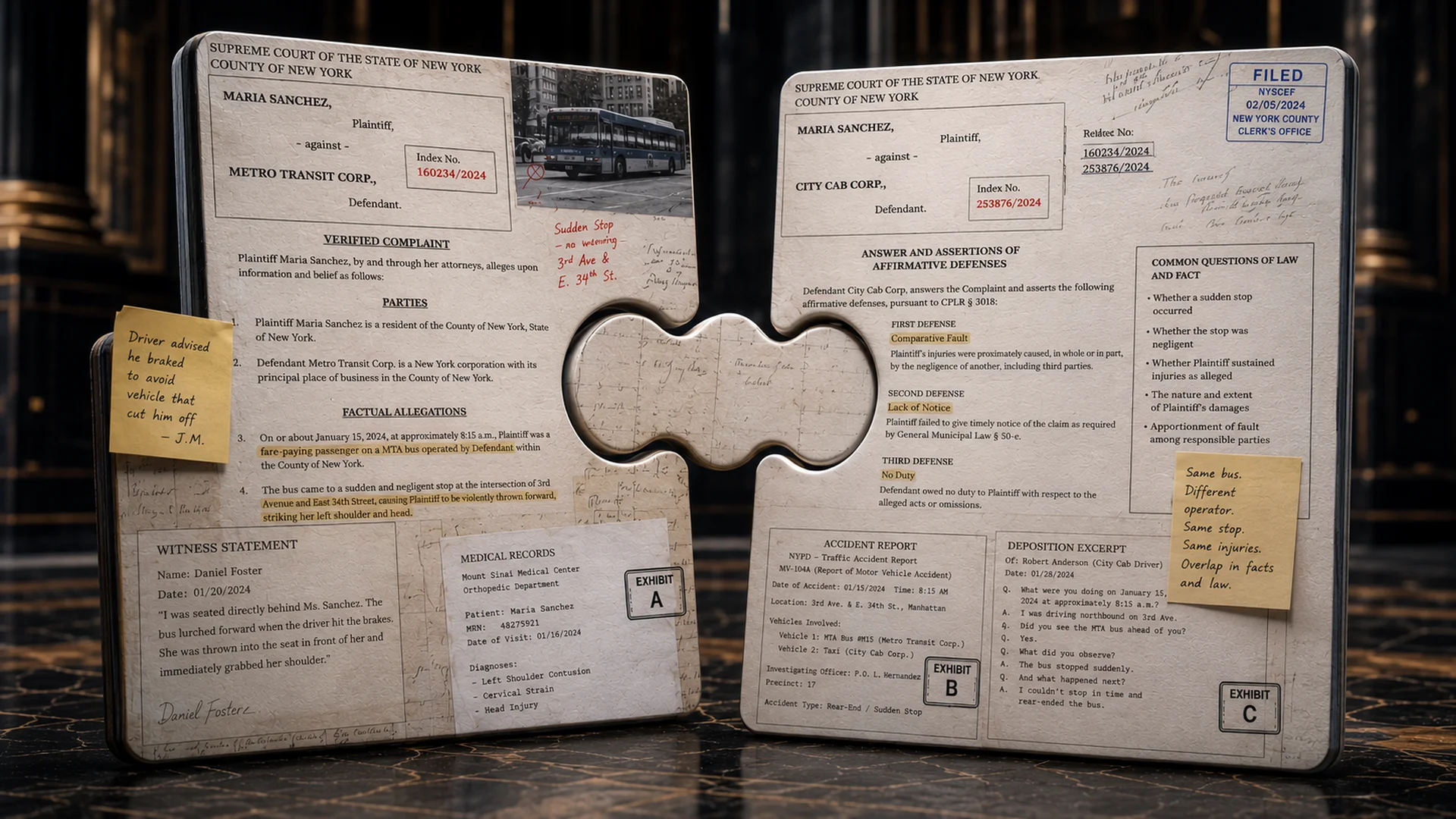
New York Civil Practice Law and Rules (CPLR) § 1002 is the permissive joinder statute. It is the provision that determines whether multiple injured victims may combine their claims into a single lawsuit, and whether a single plaintiff may name every potentially responsible party as a co-defendant in one action rather than pursuing each in a separate proceeding. When it applies, it consolidates what might otherwise be years of fragmented litigation into a unified proceeding in which all claims, all defendants, and all relevant evidence are brought before the same court at the same time.
In This Article
Understanding the New York Permissive Joinder Law
Permissive joinder is the legal mechanism that allows multiple parties (whether plaintiffs or defendants) whose claims or liabilities share a common factual or legal origin to be combined into a single lawsuit rather than forced into separate proceedings. The word "permissive" is important: the statute does not require parties to consolidate. It authorizes them to do so when the conditions are met.
The statute serves two distinct functions depending on whether it is multiple plaintiffs or multiple defendants. Under Subsection (a), multiple injured victims who were harmed by the same events may sue together as co-plaintiffs in a single action, pooling their claims rather than each pursuing a separate case against the same set of defendants. Under Subsection (b), a single injured plaintiff may name every potentially responsible party as a co-defendant in one action, regardless of whether each defendant participated in every act of negligence alleged.
The practical purpose of this consolidation is threefold. First, it avoids the risk of conflicting verdicts across separate courtrooms, where two judges or juries evaluating the same underlying facts could reach inconsistent conclusions about how an accident happened or who was at fault. Second, it forces all parties to participate in unified discovery, so that no defendant can withhold documents or testimony that another party in a separate proceeding would have demanded. Third, it ensures that an injured party is not strategically disadvantaged by having to re-litigate the same core facts against different defendants one lawsuit at a time, while the statute of limitations continues to run against those not yet named.
Statutory Eligibility Requirements
CPLR § 1002 imposes a two-prong test to determine if joinder is proper under the given circumstances. Both prongs must be satisfied. The standard is deliberately broad and is construed liberally by New York courts.
The Transactional Nexus Test
The claims must arise out of the same transaction, occurrence, or series of transactions or occurrences. A single accident qualifies on its own. So does a connected chain of events, such as an initial injury followed by negligent medical treatment at the hospital that received the patient, provided the events are sufficiently linked in time, origin, and subject matter. Courts in New York interpret this requirement broadly and do not require that every party participated in every event that forms part of the series.
The Commonality Test
There must be at least one common question of law or fact that would arise in the action. The threshold is deliberately low. A single shared factual dispute, such as whether a road condition was dangerous, whether a product was defective, or whether a workplace safety protocol was violated, satisfies this prong even where the individual parties' liability theories differ substantially. There is no requirement that every factual or legal question be shared among all parties.
Relief in the Alternative
The statute expressly permits relief to be demanded jointly, severally, or in the alternative. A plaintiff does not need to know with certainty which defendant caused the harm before joining them all. Uncertainty about fault is a reason to join, not a reason to wait. Discovery is the mechanism for resolving that uncertainty, not a precondition to joinder.
The Five Core Scenarios Where Joinder Applies in Injury Claims
The following scenarios illustrate how the two-prong test operates in the personal injury context most commonly encountered in New York litigation.
Multi-Vehicle Pileups
When a chain-reaction highway collision injures multiple occupants across several vehicles, each injured party shares a transactional nexus (the same crash) and common factual questions about road conditions, driver conduct, and causation. All injured plaintiffs may join as co-plaintiffs, and all negligent motorists may be named as co-defendants, in a single action. Consolidation prevents the same accident from being litigated repeatedly across separate cases with potentially inconsistent findings on how the collision occurred.
Successive Tortfeasors and Malpractice
Where a plaintiff suffers an initial injury caused by one party's negligence and then sustains additional harm through negligent medical treatment of that injury, both the original tortfeasor and the medical providers may be joined as defendants in one action. The transactional nexus runs from the precipitating event through the treatment that followed, and the common factual questions, including the nature and extent of the original injury, link both sets of defendants. Joinder prevents the original tortfeasor from arguing at trial that all of the plaintiff's damages were caused by the hospital, while the hospital argues in a separate proceeding that the original defendant bears the full blame.
Mass Toxic Exposure and Defective Products
When dozens of individuals are harmed by the same defective consumer product or the same localized toxic release, each injured party's claim satisfies both prongs: the transactional nexus is the product or the exposure event, and the common questions of law and fact, including whether the product was defective, whether the manufacturer had notice, and whether the exposure exceeded safe levels, are shared across every plaintiff's case. Co-plaintiff joinder in this context consolidates expert witness costs, aligns discovery, and prevents the defendant from relitigating settled science in successive individual trials.
Alternative Liability and Uncertain Blame
Where a plaintiff knows the injury was caused by one of two or more identifiable defendants but cannot yet determine which one, joinder in the alternative is expressly permitted under CPLR § 1002. The plaintiff need not resolve that uncertainty before filing; discovery is the mechanism for doing so. Naming both defendants from the outset ensures that the statute of limitations does not expire against the responsible party while the plaintiff waits for evidence that would allow a definitive identification.
Employer and Employee Under Respondeat Superior
When a negligent employee causes injury while acting within the scope of employment, both the individual employee and the employer may be joined as co-defendants in a single action. The transactional nexus is the employee's conduct, and the common legal question of whether the employer is vicariously liable for that conduct, ties both parties to the same proceeding. Naming only the employee and later attempting to add the employer risks running into statute of limitations problems if the employment relationship is not identified until after the filing deadline has passed.
The Strict Protections Against Party Prejudice
Subsection (c) is the statute's internal fairness mechanism. It prevents joinder from becoming a procedural weapon used to embarrass, burden, or delay a defendant whose connection to the litigation is genuinely limited.
The core rule is that a defendant is not automatically entitled to dismissal or severance simply because the plaintiff has not asserted a claim against that defendant in every count of the complaint, or because that defendant has no cross-claim against a co-defendant. Partial involvement in the litigation does not defeat proper joinder; it is the expected result when multiple defendants are named in a case involving overlapping but distinct acts of negligence.
Where a party can demonstrate that its inclusion alongside unrelated claims causes genuine embarrassment, delay, or financial burden, the court may issue protective orders limiting that party's discovery obligations, order that certain claims be tried separately, or take other measures proportionate to the prejudice shown. The court has broad discretion in selecting the appropriate remedy, and that discretion extends to structuring the entire proceeding, not merely to ruling on discrete motions.
A court-ordered separate trial resolves the fairness concern without destroying the underlying joinder. The claims remain part of the same action for purposes of discovery and case management; they are simply tried before the factfinder in a sequence that prevents one defendant's conduct from contaminating the jury's evaluation of another. Severance of a trial is not dismissal of a claim.
Strategic Value in High-Stakes Claims
In cases involving catastrophic injury, permanent disability, or wrongful death, the gap between the insurance coverage of any single defendant and the full measure of the plaintiff's damages is often substantial. Joinder becomes a critical financial instrument in those cases, and not merely a procedural convenience.
When a plaintiff names only one of several potentially liable parties, the named defendant's trial strategy will often involve pointing to the absent party as the true cause of the harm. This is the empty chair defense: the defendant argues to the jury that the real blame belongs to someone who is not present to answer. Joining all liable defendants eliminates the procedural precondition for that argument and forces every responsible party to answer for its own conduct in the same courtroom, in front of the same jury, at the same time.
The discovery advantage that comes with full joinder is also significant. When all defendants are parties to the same action, each defendant's documents, internal communications, and witnesses are subject to unified discovery demands. A defendant who might have remained strategically silent in a separate proceeding, withholding evidence harmful to its own interests, cannot do so when a co-defendant is entitled to demand that same evidence through its own discovery requests. Unified discovery produces a more complete evidentiary record than any series of standalone cases would.
Consolidating expert witnesses across a single proceeding rather than duplicating them across multiple cases also reduces the litigation costs that might otherwise make a serious injury claim economically unviable for a plaintiff of limited means. Medical experts, accident reconstruction specialists, and economists retained once for a unified proceeding serve the same evidentiary function that would otherwise require separate retention and separate fees in each individual case.
Finally, the statute of limitations creates a permanent consequence for delay. Once a defendant is omitted and the limitations period expires on claims against that party, the plaintiff may be permanently foreclosed from recovery against them, regardless of how clear that party's liability may later appear. Joinder at the outset preserves optionality. Delay forfeits it.
Sternberg Injury Law Firm PC
The personal injury attorneys at Sternberg Injury Law Firm PC represent injured claimants and their families in personal injury, medical malpractice, and wrongful death cases throughout New York, including cases involving multiple plaintiffs and multiple defendants. Any injured claimant or family member who wants to understand whether all responsible parties can be named in a single action should speak with an attorney as soon as possible. We offer free consultations and can be reached by phone, text, or email. Our team speaks in many different languages.
NY CPLR § 1002 Frequently Asked Questions
No. Joinder is evaluated at the time of filing based on whether the transactional nexus and commonality requirements were met, not at the verdict. A defendant who is ultimately found not liable simply prevailed on the merits; that outcome does not make the joinder improper or expose the plaintiff to sanctions.
Yes, if the statute of limitations against that defendant has not yet expired. The plaintiff can seek leave to amend the existing complaint under CPLR §§ 1003 and 3025 rather than file a separate action. Act promptly; the available window narrows as the deadline approaches.
No. The two-prong eligibility test asks only whether the claims share a transactional nexus and a common question of law or fact; the size of anyone's damages is irrelevant to that determination. If the disparity later creates a risk of jury prejudice, a separate trial on damages can be requested through Subsection (c)'s severance mechanism.
The defendant can move for a separate trial or protective orders under Subsection (c) or file a formal severance motion under CPLR § 603. The court can also limit that party's discovery exposure. The remedy is structural relief, not removal from the action.
A judgment in the first case can expose the plaintiff to claim preclusion (res judicata) and issue preclusion (collateral estoppel) in the second. A defendant in the follow-on case may argue that factual findings from the first judgment control the outcome, including findings on fault, causation, or the extent of damages that have already been compensated.