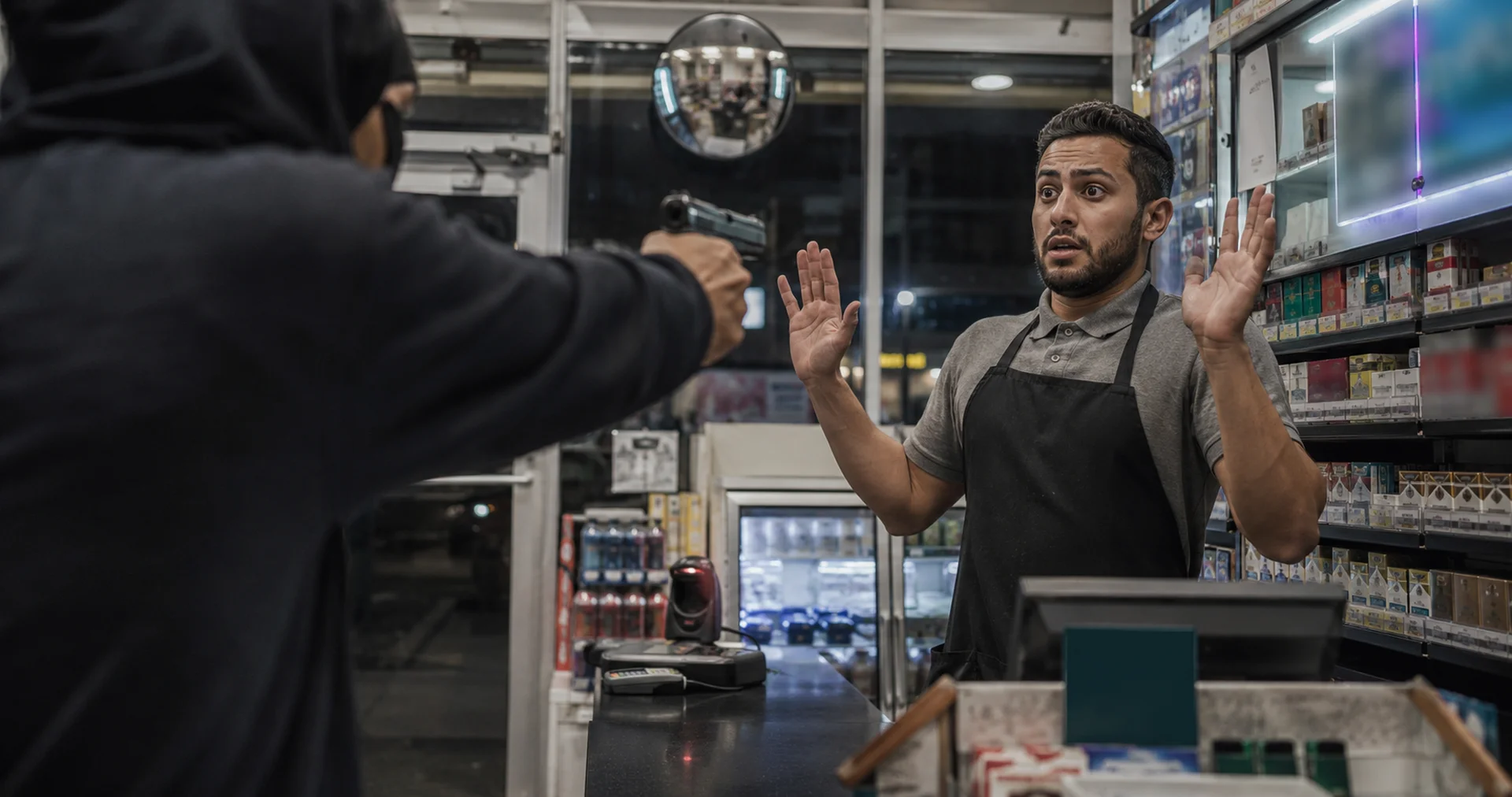
Retail work carries risks that are easy to overlook until something goes wrong. New York State has responded to the documented rise in workplace violence incidents in retail settings by enacting Article 27-E of the Labor Law, commonly called the Retail Worker Safety Act. The statute imposes specific obligations on retail employers to assess hazards, implement violence prevention programs, and install emergency alert systems. For injured workers, understanding what this law requires, and where its limits lie, is essential context for evaluating any legal claim.
In This Article
What Is Article 27-E of the New York Labor Law?
The statute was enacted in response to a documented pattern of incidents in retail environments: robberies, assaults, and situations where the absence of basic safety protocols contributed significantly to worker injuries. Rather than leaving the definition of reasonable employer conduct to case-by-case judicial interpretation, the legislature codified it, setting a statewide statutory baseline that applies to all covered retail employers in New York.
Article 27-E is a regulatory compliance statute. It creates obligations enforced by the New York State Department of Labor. It does not automatically establish civil liability, but its requirements are highly relevant to how courts and juries assess what constitutes reasonable care in a retail workplace violence case.
Who Must Comply With the Retail Worker Safety Law?
The Retail Worker Safety Act applies to retail employers operating in New York State. This includes both large chain retailers and smaller independently owned shops engaged primarily in selling goods directly to consumers. The statute covers employees working across all roles within covered retail operations, from sales floor associates and stock room workers to cashiers, overnight shift employees, and those who handle cash or interact regularly with the public.
Overnight and late-night retail workers are among those the statute was most directly intended to protect, given the elevated risk profile associated with reduced staffing, lower foot traffic, and heightened vulnerability to robbery. The specific definitional boundaries of who qualifies as a "retail employer" under the statute, including any applicable employee count thresholds, are set out in the law and implementing regulations. Because those parameters may continue to evolve as agencies issue guidance, employers should monitor official regulatory sources for current requirements.
Key Safety Requirements Under Article 27-E
Workplace Violence Prevention Programs
At the core of Article 27-E is a requirement that retail employers develop and maintain written workplace violence prevention programs. These programs must go beyond a policy statement: they are expected to include documented risk assessments specific to the employer's retail environment, identification of hazard factors such as cash handling, late hours, or high-crime locations, and defined procedures for incident documentation and internal reporting. The written program must reflect the actual conditions of the workplace, not a generic template.
Silent Alarm and Emergency Response Requirements
One of the more operationally significant provisions of Article 27-E, phased in as part of the 2027 compliance timeline, requires covered retail establishments to install silent alarm systems or comparable emergency notification technology. These systems are intended to allow employees to summon law enforcement quickly and discreetly during a robbery or assault, without alerting an offender or escalating the situation. The statute calls for coordination with local law enforcement to ensure effective response to activated alarms. For higher-risk retail environments, including those operating late-night hours or handling significant cash transactions, this requirement represents one of the most concrete security investments the law mandates.
Employee Training and Safety Procedures
Article 27-E also requires that covered employers provide meaningful employee training on workplace violence prevention. This includes de-escalation techniques for diffusing tense customer interactions before they turn violent, emergency response procedures specific to the retail setting, and instruction on how to use any alarm or notification systems installed on site. The statute anticipates ongoing compliance, meaning one-time training is likely insufficient. Employers are expected to maintain records of training completion and conduct periodic retraining as circumstances and personnel change.
2027 Compliance Deadlines and What Retailers Must Do Now
Article 27-E uses a phased implementation approach. Not all requirements take effect simultaneously, and the distinction between current obligations and future mandates matters both for regulatory compliance and for understanding what standards apply at any given point in time.
These obligations are current. Waiting until closer to the 2027 deadline to begin compliance carries regulatory risk and leaves workers unprotected in the interim.
Assessments are not a one-time exercise. The statute treats hazard evaluation as a continuing obligation as conditions, staffing, and locations change.
Physical installation takes time. Retailers should be coordinating with vendors and local law enforcement now, well before the deadline arrives.
Non-compliance exposes retailers to investigation and potential citation by the New York State Department of Labor. More broadly, an employer that has not taken the required steps to address foreseeable violence risks faces heightened exposure if a worker is injured and the circumstances reveal that mandated safeguards were absent.
How Article 27-E Impacts Personal Injury and Negligent Security Claims
A question that frequently arises is whether a retail employer's failure to comply with Article 27-E creates an automatic basis for a civil lawsuit. The answer is no, at least not directly. Article 27-E is a regulatory statute, and it does not, on its face, create a private cause of action for injured workers. An employee cannot sue an employer simply by pointing to a statutory violation and claiming entitlement to compensation.
What the statute can do is contribute to a civil claim by helping establish the applicable standard of care. In a negligence or negligent security case, the central question is whether the defendant acted reasonably under the circumstances. Evidence that an employer was required to install a silent alarm system, was aware of that requirement, and failed to do so is the kind of evidence that can speak to foreseeability and the adequacy of the safety measures in place. Similarly, the absence of a mandated training program may be relevant to whether a preventable incident was, in fact, preventable.
Retail Store Liability for Workplace Violence Incidents
Under New York premises liability law, property owners and operators, including retail stores, owe a duty of reasonable care to those on their premises. When it comes to criminal acts by third parties, that duty extends to foreseeable risks. A retailer who knows, or reasonably should know, that its location presents an elevated risk of robbery or violent confrontation has an obligation to take reasonable steps to address that risk. The failure to do so can be the basis of a negligent security claim.
Foreseeability is the central inquiry. Courts look at whether prior incidents at the same location, on the same block, or in comparable retail environments put the store owner on notice that a violent incident was not merely possible, but reasonably likely. Where that foreseeability threshold is met, staffing decisions, environmental design choices, alarm system installations, and security protocols all become part of the analysis of whether the retailer's response was adequate.
Key Court Decisions Relevant to Retail Safety and Liability
The following cases do not interpret Article 27-E directly; the statute is relatively new and has not yet generated an extensive body of decisional law. What these decisions do is establish the common law principles that govern how courts analyze premises liability and security claims in commercial settings, including retail environments.
Nallan v. Helmsley-Spear, Inc., 50 N.Y.2d 507 (1980)
This Court of Appeals decision remains foundational in New York premises security law. The court held that a property owner's duty to provide reasonable security is grounded in foreseeability: the owner must take precautions commensurate with the risks it knows or should know exist at the property. Nallan established that security is not an elective amenity, but a duty tied to circumstances, and it continues to anchor how New York courts frame negligent security analysis across commercial and retail contexts.
Banayan v. F.W. Woolworth Co. (1995)
In this retail-specific premises liability matter, the court examined the connection between a retailer's security infrastructure and its legal exposure when a customer or worker was harmed by a third-party criminal act on the premises. Banayan illustrates how the adequacy of a retailer's physical security measures, including staffing levels and the presence or absence of deterrent systems, factors into the duty and breach analysis in negligent security litigation.
Matter of City of New York v. Commissioner of Labor (2011)
While not a personal injury case, this decision is instructive on how New York courts evaluate the scope of the Department of Labor's authority to interpret and enforce workplace safety statutes. It illustrates the deference courts extend to agency regulatory findings and underscores the significance of enforcement actions taken under occupational safety frameworks. For Article 27-E purposes, the Decision provides relevant context for understanding how regulatory determinations can interact with civil litigation.
Common Retail Workplace Injury Scenarios Covered by Article 27-E
Armed robbery with no emergency notification system. A convenience store operating late-night hours is robbed at gunpoint. The employee on duty has no means to silently alert law enforcement because the store lacks the alarm infrastructure required under Article 27-E. The employee is assaulted. The absence of the mandated alarm system is a central factual issue in both the regulatory investigation and any civil claim.
Shoplifting confrontation that turns violent. A retail employee is trained to confront suspected shoplifters and physically prevent their exit. No de-escalation training was provided. The confrontation escalates; the employee is seriously injured. The employer's failure to provide the violence prevention training required under the statute is directly relevant to whether the employer met its legal obligations.
Late-night assault on a solo shift worker. An employee working alone in a large retail store during overnight hours is attacked. The store's risk assessment, required under Article 27-E, was never conducted, and the inherent vulnerability of solo overnight work was never identified or addressed. The employer's failure to perform the mandated assessment goes to whether the risk was foreseeable and whether reasonable precautions were taken.
Escalating customer dispute with no intervention protocol. A customer becomes increasingly aggressive toward a sales associate. No trained response protocol exists, and staff are unsure how to respond or call for help. The situation escalates into a physical assault. The absence of any workplace violence prevention program, one of the statute's baseline requirements, is relevant to the standard of care analysis.
Differences Between Article 27-E and General Premises Liability Law
Article 27-E and New York premises liability law operate in parallel but serve distinct legal functions. Conflating them leads to inaccurate analysis of what a claimant must prove and what remedies are available.
| Framework | Nature | Enforcement | Effect on Civil Claims |
|---|---|---|---|
| Article 27-E | Regulatory statute prescribing minimum employer conduct in retail safety | New York State Department of Labor: complaints, investigations, citations, penalties | No automatic private right of action; may inform standard of care and foreseeability in civil litigation |
| Premises Liability | Common law negligence doctrine governing duty of care to those on the premises | Civil courts: injured parties bring claims seeking damages | Direct mechanism for financial recovery; requires proof of duty, breach, causation, and damages |
In practice, both frameworks are often implicated by the same incident. A premises liability or negligent security claim is the mechanism for recovering damages; Article 27-E shapes the evidentiary record that supports or undermines it. How much weight a court gives to regulatory non-compliance depends on the specific facts, but when a worker is injured by a foreseeable act of violence in a retail setting, that record can be significant.
How Violations of Article 27-E Are Investigated and Enforced
Enforcement of Article 27-E rests with the New York State Department of Labor. The process is primarily complaint-driven: an employee, union representative, or other covered party can file a complaint with the Department alleging that a retail employer has failed to meet its statutory obligations. The Department may also initiate investigations as part of broader compliance monitoring efforts.
When a complaint is filed or a violation is identified, the Department conducts an investigation that may include on-site inspections, review of the employer's written programs and training records, and interviews with employees. If violations are substantiated, the Department can issue citations requiring corrective action, mandate implementation of specific safeguards, and impose civil monetary penalties. The severity of the regulatory response typically reflects the nature and duration of the violation.
In civil litigation, findings from a Department of Labor investigation are not automatically admitted as proof of negligence, and they do not establish liability on their own. However, regulatory enforcement records, including citations, inspection reports, and corrective action orders, may be relevant and potentially admissible in a civil case, depending on the context and the evidentiary rules applicable to a given proceeding. An attorney handling a civil claim can evaluate what regulatory materials may be usable and how they factor into the overall evidence strategy.
Why Retail Worker Safety Laws Matter for Injury Claims
The existence of Article 27-E changes the evidentiary landscape in retail workplace violence cases. Before this statute, the attorney for an injured retail worker had to construct the standard of care argument from the ground up, drawing on industry custom, expert testimony, and prior incidents to establish what a reasonable employer should have done. Article 27-E supplies a legislatively defined baseline.
That shift matters most in serious and catastrophic injury cases, where the stakes justify rigorous scrutiny of every security decision an employer made. It does not determine the outcome, but it changes the terrain on which the case is fought.
Personal Injury Lawyer for Retail Worker Injuries in New York
If you were injured in a workplace violence incident at a retail location in New York, understanding what the law required of your employer is an important first step. Whether Article 27-E violations are relevant to your situation, and how they interact with a potential premises liability or negligent security claim, depends on the specific facts of what occurred and what safeguards were or were not in place.
The personal injury attorneys at Sternberg Injury Law Firm have experience handling workplace injury claims and negligent security cases across New York. We can evaluate the facts of your situation, assess whether the employer's security practices met the applicable legal and regulatory standards, and advise you on what options may be available. We offer complimentary consultations and can arrange to meet at your home, medical facility, or another convenient location. Our team assists clients in multiple languages, including Creole, English, Hebrew, Hindi, Russian, Spanish, Urdu, Uzbek, and Yiddish.
GET A FREE CONSULTATION TODAYArticle 27-E Frequently Asked Questions
Article 27-E is a regulatory statute enforced by the New York State Department of Labor. It does not automatically create a private right of action against an employer. However, evidence of a violation may be relevant in a civil negligence or negligent security claim brought under common law principles. The specific facts and circumstances of each case determine what legal options are available.
The Retail Worker Safety Act generally applies to retail employers operating in New York State. The law covers a broad range of retail settings, including chain stores, independent shops, grocery stores, pharmacies, and other establishments primarily engaged in selling goods directly to consumers. Specific coverage thresholds and definitions are set forth in the statute and implementing regulations.
The silent alarm and certain other enhanced security requirements are part of the phased implementation timeline under the Retail Worker Safety Act, with key mandates scheduled to take effect by 2027. Retailers should monitor guidance from the New York State Department of Labor for specific deadlines and technical specifications as implementing regulations are finalized.
Evidence of an Article 27-E violation may be offered in civil litigation as evidence bearing on the standard of care or the foreseeability of harm. It is not, by itself, proof of negligence or a guarantee of liability. Courts evaluate negligent security claims under common law principles, considering the totality of the circumstances, including the nature of the location, prior incidents, and the adequacy of security measures.
If you were injured in a retail workplace violence incident, seek medical attention immediately. Document the scene if it is safe to do so, report the incident to management and request a written incident report, and preserve any witness information or communications. Because deadlines for pursuing legal claims vary depending on the circumstances, consulting a licensed New York personal injury attorney as soon as possible is strongly advisable.
Enforcement is primarily complaint-driven. When a complaint is filed or a violation is identified, the Department of Labor may conduct an investigation and, if violations are found, issue citations, require corrective action, or impose civil penalties. Findings from regulatory enforcement proceedings may be referenced in civil litigation, but they are not automatically determinative of civil liability.