New York Impleader Law Update: CPLR § 1007 Deadlines and the AVOID Act
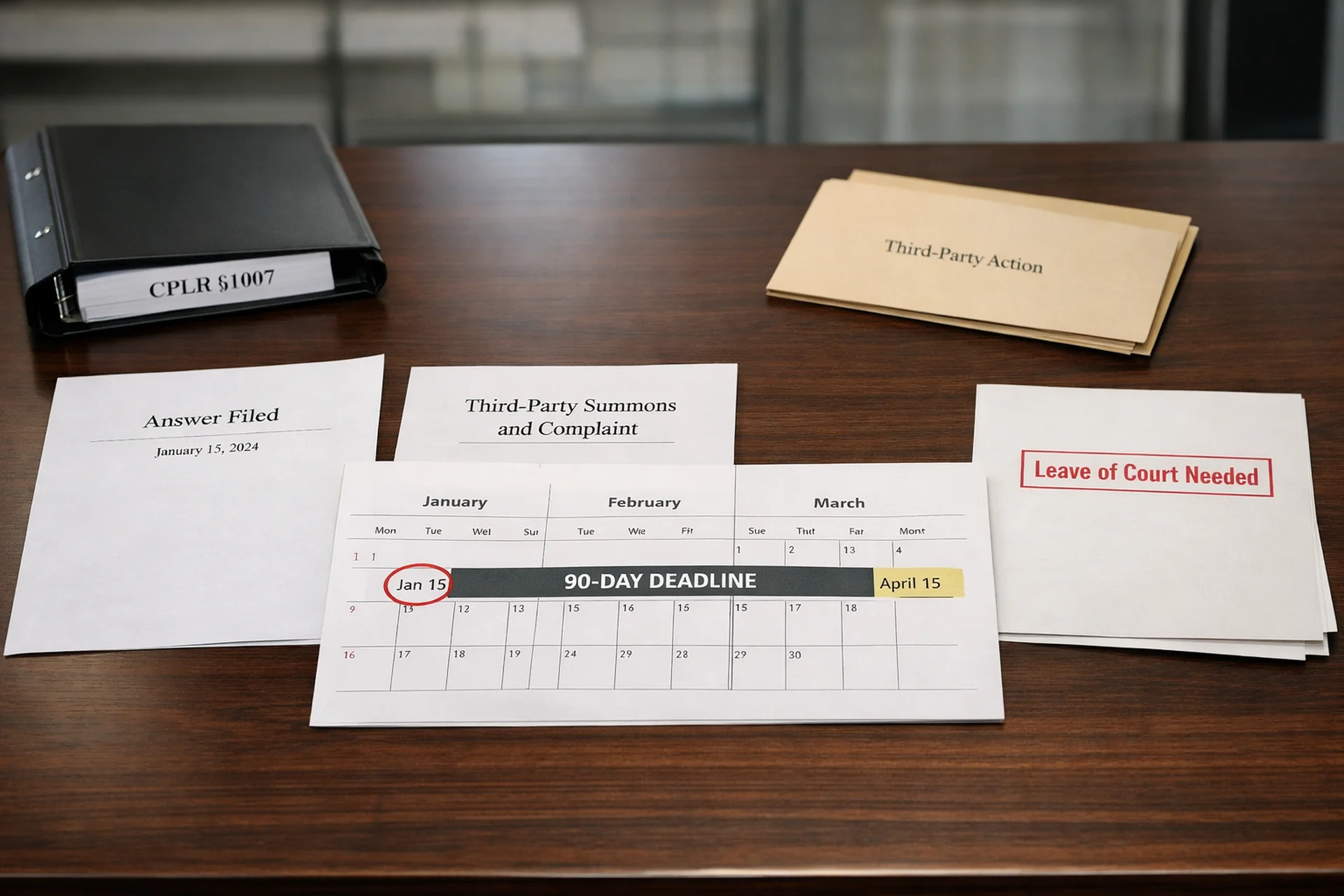
Third-party practice, often called impleader, allows a defendant to bring another person or company into a lawsuit and argue that the new party should pay for all or part of the plaintiff's damages. Before 2026, Civil Practice Law and Rules (CPLR) § 1007 allowed impleader after service of the Answer but did not set a firm outside deadline. In practice, courts often focused on whether a late third-party claim would delay the case or unfairly prejudice the plaintiff. The Avoiding Vexatious Overuse of Impleading to Delay (AVOID) Act changes that structure. In general, a defendant now has ninety days after serving an answer to file a third-party summons and complaint against another possible defendant without a court order. Claims against a plaintiff's employer follow a separate ninety-day rule tied to when the employer is identified or when a grave injury becomes known. The amended law also significantly limits filings made after the note of issue.
The practical effect is that defendants have less time to wait. They now need to investigate possible third-party claims at a much earlier stage, rather than waiting until discovery is well underway or the case is approaching trial. For injured people, that may mean fewer last-minute disruptions, fewer scheduling problems, and a greater likelihood that the main case continues to move forward.
- It replaces open-ended impleader timing with a general ninety-day deadline.
- It requires a court order if a defendant wants to file after that default period.
- It substantially restricts post-note-of-issue filings and limits them to narrow court-approved exceptions.
- It keeps a separate timing rule for certain claims against a plaintiff's employer.
- It allows untimely filings to be severed or dismissed without prejudice.
The New Impleader Deadlines
The principal change is that defendants can no longer wait indefinitely to bring in another party. Under amended CPLR § 1007, a defendant generally has ninety days after serving an answer to file a third-party summons and complaint without a court order. After that point, the defendant generally needs the court's permission to proceed.
That is a major change from the pre-2026 framework. In the old system, late impleader fights often turned on whether the delay was tolerable and whether the plaintiff would be prejudiced. Stein v. Yonkers Contracting illustrates that earlier approach, because it reflects the more liberal era of third-party practice. The AVOID Act changes the starting point. Now the first question is whether the defendant acted within the statute's time limit.
For plaintiffs, the practical effect may be significant. A defendant who might have waited for depositions, document exchange, or later contract review before adding another party must now investigate those issues much earlier. The goal is to reduce the kind of late third-party filings that can slow down a personal injury case.
Judicial Discretion and Strict Deadlines
The AVOID Act does not remove judges from the process, but it leaves them with less room to excuse delay. Once the ninety-day period has passed, a defendant ordinarily needs court approval to bring in another party. That is a meaningful shift from the older system, where courts had broader flexibility to manage late impleader through case-by-case balancing.
Miceli v. State Farm helps explain why this matters. The Court of Appeals made it clear there that statutory deadlines are not mere suggestions. Even a strong claim can encounter difficulty if it is brought too late. Although Miceli did not involve CPLR § 1007, the same basic lesson applies here: a potentially valid third-party claim still must be timely.
In practical terms, defendants now have to move faster, keep track of the relevant dates, and be prepared to explain any delay. That is a materially different framework from the older liberal impleader rules.
Mandatory Severance and the "Note of Issue" Barrier
The rule becomes even more restrictive once a note of issue is filed. A note of issue usually means discovery is complete and the case is ready for trial. Under the AVOID Act, filing a new third-party complaint after that point is generally not allowed unless the court finds good cause or concludes that it is in the interest of justice. If the filing violates the statute, the third-party action may be severed or dismissed without prejudice.
That matters because it changes the legal fight. Before the amendment, courts often handled late third-party filings by balancing prejudice, delay, and trial readiness. Ervolina v. City of Buffalo illustrates that earlier approach. The amended CPLR § 1007 narrows that flexibility. Once the statutory line is crossed, the defendant faces a substantially heavier burden.
The practical consequence is clear. Once a case is close to trial, adding a new party becomes substantially more difficult. Even if a third-party claim survives in a separate action, it may remain outside the main lawsuit, and the amended statute bars later consolidation of a severed action back into the original case.
Before the AVOID Act, a plaintiff opposing late impleader often had to focus on prejudice and delay. Now the plaintiff can also point directly to the statute's deadlines. That may make it easier to argue that a trial-ready case should not be reopened by a late third-party dispute.
The Employer Exception
This part matters because claims against an injured worker's employer are already restricted by Workers' Compensation Law § 11. As a general rule, the employer cannot be brought into the case unless there is a qualifying grave injury or a qualifying written indemnification obligation. The AVOID Act does not expand who can sue the employer. It changes timing, not the underlying legal standard.
Castro v. United Container remains important because it reflects the Court of Appeals' narrow reading of "grave injury" under Workers' Compensation Law § 11. That phrase does not simply mean a very serious injury in the ordinary sense. It refers to a limited statutory category of specific harms. So, the 2026 amendment does not broaden the class of injuries that qualify.
The timing rules are different, however. A defendant or third-party defendant generally has ninety days from the later of two events: when the employer's identity becomes known, or when the defendant knows or should know that the plaintiff suffered a grave injury. That recognizes a practical reality in construction and workplace cases: the factual basis for an employer claim may emerge later. But it does not relax the limits imposed by Workers' Compensation Law § 11.
How This Can Affect Your Personal Injury Case
For injured people, one immediate effect may be greater predictability later in the case. Earlier third-party investigation may reduce the chance that a lawsuit close to trial expands to include new indemnity or contribution disputes. That may affect discovery, scheduling, and settlement discussions.
That does not mean timing disputes will disappear. Parties may still litigate over when the defendant knew enough to act, whether the court should allow a late filing, and whether any claim must proceed in a separate action. Those issues can still affect cost and settlement leverage even if the main case stays on track.
The larger point is that the AVOID Act moves third-party issues to the beginning of the case. The law is meant to reduce late-stage disruption, but its real impact will depend on how courts apply the new rules in actual cases, especially where the facts are still developing early on.
Contact Sternberg Injury Law Firm About the AVOID Act and Your Personal Injury Case
The personal injury attorneys at Sternberg Injury Law Firm have handled car accidents, slip and fall accidents, and other personal injury cases throughout New York. We can evaluate how the AVOID Act affects your case, identify potential third-party defendants early, and build the strongest possible claim from the outset. We offer free consultations and can meet with you at our office, your home, a hospital, or another convenient location. Contact us at your convenience.
Frequently Asked Questions
Impleader is the process that allows a defendant to bring another person or company into the lawsuit and claim that the new party should be responsible for all or part of the plaintiff's damages. This is done by filing a third-party summons and complaint under CPLR § 1007.
The AVOID Act replaced open-ended impleader practice with an earlier filing deadline. In general, a defendant now has 90 days after serving an answer to file a third-party claim without a court order. Claims against a plaintiff's employer follow a separate 90-day rule tied to when the employer is identified or when a grave injury becomes known.
If the deadline is missed, the defendant generally needs court permission to bring in the third party. If the case is already at the note-of-issue stage, the standard is even stricter, and a filing that violates the statute may be severed or dismissed without prejudice.
A Note of Issue is the filing that tells the court the case is ready for trial. Under the AVOID Act, adding a new third-party claim after that point is generally not allowed unless the court finds good cause or decides it is in the interest of justice.
The law limits last-minute third-party filings that previously delayed cases. This can lead to more predictable timelines, fewer procedural delays, and earlier resolution of claims involving car accidents, construction accidents, and other injury cases.