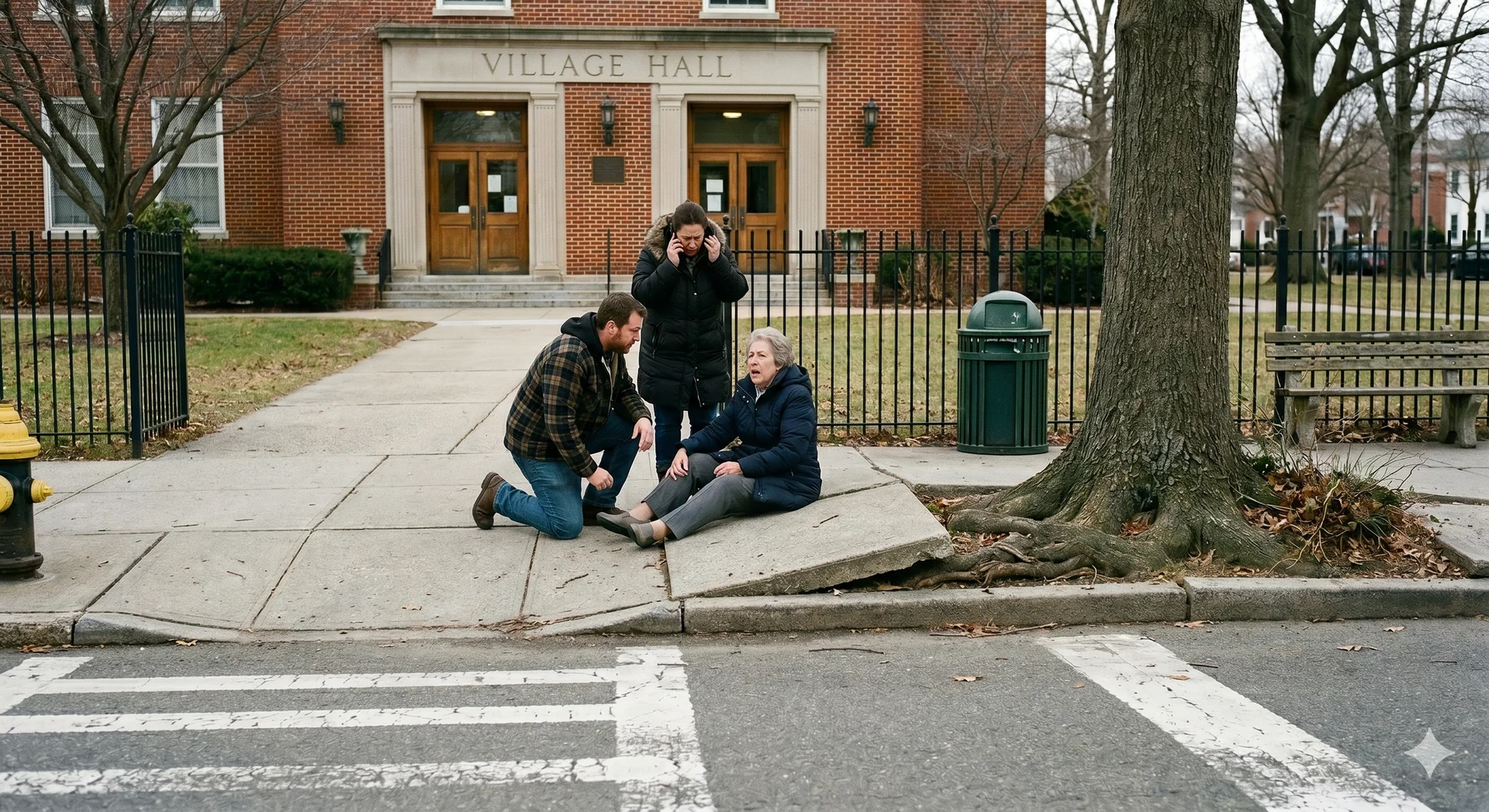
In New York State, a village is a voluntary municipality formed by residents within one or more towns. New York Civil Practice Law and Rules (CPLR) § 9802 is the procedural statute that controls personal injury lawsuits filed against a New York Village. Because villages enjoy a form of limited governmental immunity, this statute functions as a gatekeeping mechanism that forces injured claimants to satisfy specific procedural conditions before a court will hear their case. Missing any one of these conditions, regardless of how severe the injury or how clear the village's negligence, results in an automatic bar to recovery and a permanent loss of the right to sue.
In This Article
Understanding the NY Village Liability Law
CPLR § 9802 establishes two distinct procedural tracks. For personal injury, wrongful death, property damage, and other non-contractual claims, the statute mandates compliance with a notice of claim requirement, a 40-day waiting period, and a one-year filing deadline. A separate contractual track governs breach of contract actions against villages, which operate under different timelines.
The statute applies strictly to incorporated villages in New York. It does not apply to towns, cities, or counties, each of which operates under separate municipal liability statutes with different procedural requirements. Whether the entity responsible for the negligence is classified as a village under New York law is therefore a threshold question that must be answered before any legal strategy is built.
Courts retain discretion only in a narrow window involving late notice of claim applications under General Municipal Law § 50-e. Outside that window, there is no equitable escape hatch for a claimant who missed a deadline.
The 90-Day Notice of Claim: The First and Most Urgent Deadline
The threshold requirement under CPLR § 9802 is the notice of claim, which must be served on the village in strict compliance with General Municipal Law § 50-e within 90 days of the date the injury occurred. This sworn document must identify the claimant by name, describe the nature and location of the incident with specificity, detail the injuries sustained, and be formally served on a designated village official. It is not a courtesy notification; it is a mandatory legal prerequisite, and a lawsuit filed without it will be dismissed.
A claimant who misses the 90-day window may petition the court for leave to file a late notice, but that application must itself be made before the one-year statute of limitations expires and is not guaranteed to succeed. Courts evaluating a late filing application weigh whether the village had actual notice of the incident, whether the delay prejudiced the village's ability to investigate the claim, and whether the plaintiff has a reasonable excuse for the delay. None of these factors automatically tip the scale in the claimant's favor.
The Mandatory 40-Day Freeze After Filing
Once the notice of claim is filed with the village clerk, the law imposes an immediate and non-negotiable 40-day waiting period before any lawsuit may be commenced. This window gives village attorneys and municipal insurers the opportunity to investigate the incident, inspect the location, interview witnesses, and assess whether an early resolution is appropriate.
Filing a summons and complaint even one day before the 40-day period expires renders the lawsuit procedurally defective, and the defense can move for dismissal on that basis alone. Critically, if the one-year statute of limitations expires while the 40-day period is still running, the claimant has no ability to re-file; the claim is lost. This intersection creates a hard outer boundary: a notice of claim filed in the final 40 days of the one-year window will produce a waiting period that outlasts the filing deadline.
The One-Year Statute of Limitations
After the 40-day waiting period clears, the claimant's attorney must file a formal Summons & Complaint in New York Supreme Court before the one-year anniversary of the date the cause of action accrued. This timeline is much shorter than the three-year period that applies to ordinary personal injury cases under CPLR § 214.
The one-year deadline is fixed and applies regardless of the nature or severity of the injury, ongoing medical treatment, or any informal negotiations with the village. The complaint must also affirmatively plead compliance with both the notice of claim requirement and the 40-day waiting period; failure to do so leaves the case vulnerable to dismissal even if both conditions were technically met.
An infancy toll may apply if the claimant was a minor at the time of the injury, but adult claimants have no equivalent automatic extension for incapacity, hospitalization, or unawareness of the village's liability. The compressed timeline under § 9802 runs regardless of personal circumstances.
Strategic Value in Serious Injury Claims
Acting immediately after a village-related injury does more than satisfy legal deadlines; it preserves evidence that disappears fast. Defective sidewalks get repaired. Municipal vehicles get reassigned or serviced. Security footage held by village agencies gets overwritten on rolling retention schedules. Witness memories fade.
By locking in the notice of claim within days of the incident rather than approaching the 90-day edge, an experienced legal team can send preservation demands, photograph the condition before it changes, and compel the village to produce records before they are lost.
The compressed timeline under § 9802 rewards claimants who retain counsel immediately and punishes those who wait. Each day of delay narrows the evidentiary record and reduces the available window for managing the three procedural layers simultaneously.
Personal Injury Lawyer for Injuries Caused by Village Negligence
The personal injury attorneys at Sternberg Injury Law Firm represent plaintiffs in lawsuits against villages and are experienced in the necessary procedural requirements. Our team handles municipal liability cases throughout New York State. Any injured individual or family member should consult with an attorney as soon after the injury as possible but definitely before the 90-day notice window closes to ensure the claim is properly initiated, evidence is preserved, and no deadline is missed during the early investigation period. We offer free consultations and can be reached by phone, text, or email. Our staff speak many different languages.
NY CPLR § 9802 Frequently Asked Questions
No. This statute applies strictly to incorporated villages. Towns are governed by Town Law § 65-a, which requires prior written notice of the specific defect before a negligence suit can succeed, and counties operate under separate General Municipal Law provisions. Confirming the exact municipal designation of the entity responsible for the property or vehicle where the injury occurred is a threshold step before any legal strategy is built.
Actual notice to the village can sometimes be established through records that predate the formal application: an incident report completed by village employees at the scene, a prior written complaint about the same defect logged with the village clerk, or surveillance footage reviewed by municipal staff shortly after the incident. These records do not guarantee approval of a late filing, but they are among the strongest evidence a claimant can present. The application requires motion practice in Supreme Court, and the claimant bears the burden of demonstrating each factor the court weighs.
The village-held records that prove the prior condition most effectively include prior written complaints logged with the village clerk, work orders documenting the defect, municipal inspection reports, and 311 service request histories. These documents are subject to the village's own retention schedules and can be purged under routine policy if a formal preservation demand is not served promptly after the notice of claim is filed. Once those records are gone, the evidentiary burden shifts entirely to what the claimant and witnesses can reconstruct from memory.
When an adult claimant is seriously injured and physically unable to manage their own legal affairs, a family member or close associate may retain counsel and initiate the notice of claim process on their behalf. The statute does not require the injured person to act personally; it requires that a proper notice be served within the deadline. In catastrophic injury cases, this distinction matters: the clock runs regardless of the claimant's condition, but it does not require the claimant to be the one who stops it.