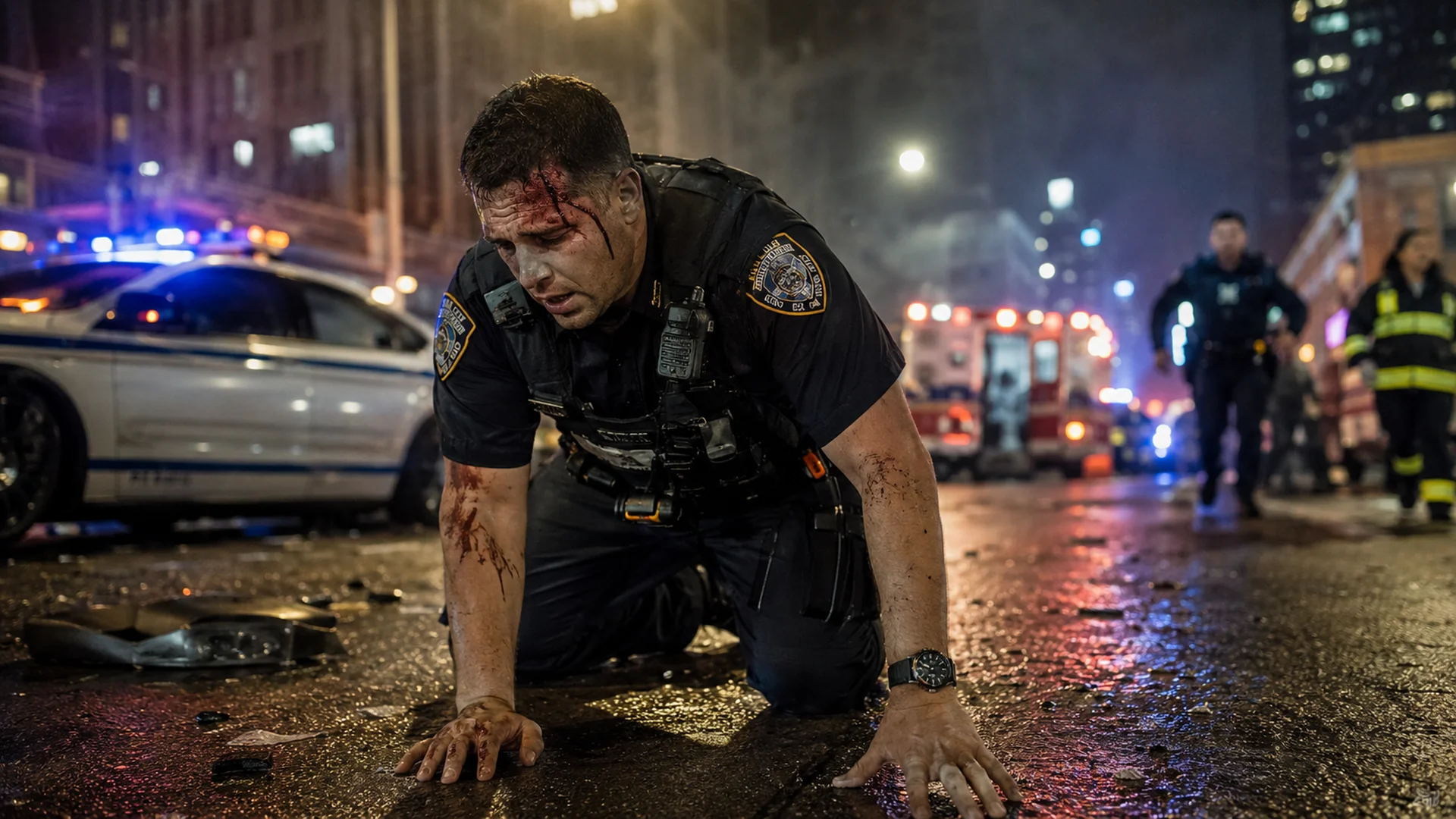
For decades, a common-law doctrine known as the "Firefighter's Rule" blocked injured police officers and firefighters from suing people that cause their injuries in the line of duty. New York General Obligations Law § 11-106, enacted in 1996, ended that doctrine and created a direct statutory right of action to sue for personal injuries.
In This Article
The Firefighter's Rule in New York and How GOB § 11-106 Changed It
The Firefighter's Rule was a common-law doctrine that barred police officers and firefighters from recovering civil damages against the very parties whose negligence summoned them into danger. A driver who ran a red light and caused an accident that injured the responding officer could not be held civilly liable to that officer under the old rule. A building owner whose failure to maintain safe conditions caused a structural collapse injuring responding firefighters was similarly shielded. The underlying theory treated line-of-duty injuries as an assumed occupational risk, one that public compensation systems, not civil tort law, were designed to address.
New York's legislature rejected that reasoning in 1996. By enacting GOB § 11-106, it created an affirmative statutory right of action where none had reliably existed before. The Firefighter's Rule, as applied to third-party defendants in New York, was abrogated. The legislature's judgment was deliberate: the party whose carelessness created the emergency should bear the civil consequence of injuries that carelessness caused, not the injured first responder alone and not the public systems that support them.
The abrogation was targeted: it applied specifically to the Firefighter's Rule as a defense for third-party defendants in civil suits brought by injured first responders.
Who Can Sue Under NY GOB § 11-106 and Who Can Be Sued
Qualifying plaintiffs. The statute covers police officers and firefighters who were in the lawful discharge of their official duties at the time of the injury. In cases where the injury results in death, a representative of the officer's or firefighter's estate may bring the action in place of the decedent. The statute is not limited to New York City employees; it applies statewide.
Third-party defendants. Any private individual, business, property owner, contractor, manufacturer, or other entity (including a governmental or municipal entity that is not the plaintiff's own employer) can be sued under GOB § 11-106, provided that entity's neglect, willful omission, or intentional, willful, or culpable conduct was the proximate cause of the injury.
Excluded defendants. The statute expressly carves out the officer's or firefighter's own municipal employer and co-employees. Claims against an employer or co-employee are governed by General Municipal Law § 205-a (for firefighters) and GML § 205-e (for police officers), not by GOB § 11-106. An attempt to use GOB § 11-106 as the vehicle for a claim against the plaintiff's own agency will be dismissed. Distinguishing between a third-party municipal entity (potentially suable under GOB § 11-106 with proper procedural compliance) and the plaintiff's own employing agency (excluded from GOB § 11-106) is one of the most consequential evaluations made at the outset of any line-of-duty case.
Additive remedy. GOB § 11-106 does not require a plaintiff to abandon any other viable recovery theory. The statute states that the right of action it creates exists "in addition to any other right of action or recovery otherwise available under law." A plaintiff may pursue GOB § 11-106 alongside GML § 205-a, GML § 205-e, common-law negligence, or products liability theories directed at the same facts without electing between them.
What "Lawful Discharge of Official Duties" Means Under NY GOB § 11-106
Courts have applied "lawful discharge of official duties" to the specific facts presented in each case. Off-duty injuries, even those sustained while performing a public-spirited act, generally fall outside the statute's coverage. An officer responding to an emergency call, conducting a lawful patrol, or carrying out an authorized enforcement function satisfies the element. An officer technically on the clock but engaged in personal activity at the time of injury does not. The ambiguity tends to surface in cases involving meal breaks, off-route travel, or unofficial tasks performed during a shift.
Early factual development of the officer's duty status at the precise moment of injury is not a formality. Defendants routinely contest this threshold element when the facts are in dispute, and a case cannot advance to liability and damages analysis until it is resolved.
Full Tort Damages: What You Can Recover Under NY GOB § 11-106
Workers' Compensation and line-of-duty disability benefits are formulaic. They replace a percentage of wages, cover medical expenses within defined categories, and provide no compensation for pain or suffering. GOB § 11-106 operates on a different basis: it provides full common-law tort damages, the same categories available to any injured plaintiff in a New York negligence action.
Pain and suffering. Compensation for the physical pain, emotional distress, and diminished quality of life the injury caused. This component is categorically unavailable through Workers' Compensation, and in serious cases it is often the largest element of a GOB § 11-106 recovery.
Future lost wages and earning capacity. Where the injury impairs the plaintiff's ability to work, damages include the income that will be lost going forward, including the difference between what the plaintiff would have earned and what the plaintiff can now earn.
Past and future medical expenses. Reasonable costs of all treatment, surgery, rehabilitation, and continuing care caused by the defendant's conduct.
Wrongful death damages. In fatal cases, the estate may recover for the economic contributions the deceased would have made to surviving family members. A conscious pain and suffering claim may also be available if the officer or firefighter survived the injury for any period before death.
No statutory floor. Unlike GML § 205-a and GML § 205-e, which carry specified minimum damages for proven violations, GOB § 11-106 recovery is based on actual, proven losses. There is no guaranteed minimum, and there is no statutory ceiling either.
The Proximate Cause Standard for NY GOB § 11-106 Claims
The causation standard under GOB § 11-106 differs meaningfully from the standard that applies to GML § 205-a and GML § 205-e claims, and that difference affects how cases are evaluated and litigated.
Under GML § 205-a and GML § 205-e, a defendant who violates a statute, ordinance, or regulation can be held liable even if that violation was only an indirect contributing cause of the injury. A technical regulatory failure that set conditions in motion, even remotely, can satisfy the causation requirement. The nexus between the violation and the harm may be attenuated.
Under GOB § 11-106, the plaintiff must establish proximate causation: the defendant's conduct must be the direct cause of the injury. A causal chain broken by an independent intervening act, or attenuated by the circumstances of the emergency itself, provides stronger grounds for a defense. A defendant who created only a background condition that some other actor converted into the specific harm has more room to contest liability under GOB § 11-106 than under the GML counterparts.
This does not make GOB § 11-106 claims unwinnable. The overwhelming majority of line-of-duty injuries caused by third-party carelessness satisfy proximate causation without analytical difficulty. The standard becomes a genuine litigation issue in complex, multi-party cases and in cases where the defense argues that the officer's or firefighter's response to the emergency, rather than the defendant's original conduct, was the proximate cause of the harm.
Critical Deadlines and Procedural Rules for NY GOB § 11-106 Line-of-Duty Claims
A GOB § 11-106 claim with strong facts and provable damages can be ended prematurely by a missed procedural deadline. These requirements do not depend on the merits of the underlying case; a court has no discretion to overlook them once they have been violated.
Notice of Claim: 90 days for municipal third parties. When the negligent third party is itself a governmental or municipal entity (a different city agency, a public authority, a municipal utility, or another governmental body), a Notice of Claim must be filed with that entity within 90 days of the injury or death. This filing is a jurisdictional prerequisite, not a technical formality. Courts can and do dismiss timely-filed GOB § 11-106 lawsuits when the required Notice of Claim is late, directed to the wrong entity, or never filed at all. The 90-day window begins running on the date of the injury or death, not on the date treatment concludes or a diagnosis is confirmed.
Statute of limitations: three years for private defendants. For claims against private individuals and entities, the standard three-year negligence limitations period applies, measured from the date of the injury. There is no mechanism to revive a claim after this window closes.
Shortened lawsuit deadlines for municipal defendants. Municipal entities are subject to compressed timelines for filing the actual lawsuit, separate from and in addition to the Notice of Claim. These vary by entity type and must be confirmed against current law at the time of filing. Treating a municipal third-party defendant as though the standard three-year limitations period applies is one of the more common and consequential errors in this area of practice.
Wrongful death timing. In fatal cases, the limitations period for the wrongful death claim runs from the date of death, not the date of injury. Where injury and death are separated by a period of time, two limitations clocks may be running concurrently on overlapping but distinct schedules.
The 90-day Notice of Claim deadline begins immediately. Courts grant extensions only upon a formal application showing specific circumstances enumerated in General Municipal Law § 50-e. Early consultation with an attorney is not a general precaution; it is a procedural necessity.
When NY GOB § 11-106 Does Not Apply to a Line-of-Duty Injury
The officer or firefighter was not in the lawful discharge of official duties at the time of injury. Off-duty conduct, personal errands performed while on shift, and unauthorized activities fall outside the statute regardless of professional title.
The only available defendant is the plaintiff's own employer or a co-employee of the plaintiff's employing agency.
The defendant's conduct did not proximately cause the injury. General carelessness that had no direct causal link to the specific harm is not enough; the GOB § 11-106 claim fails even if liability existed in some broader sense.
A Notice of Claim was not timely filed against a municipal third-party defendant. That omission is not curable through the lawsuit itself. Correcting it requires a court order under GML § 50-e, which courts grant only upon a showing of specific statutory factors, including, in some circumstances, whether the municipal defendant acquired actual knowledge of the facts constituting the claim within the filing period.
The injury occurred in a joint-agency operation, task force, or mutual-aid deployment, and the defendant is an employee of a different governmental agency working alongside the plaintiff's unit. The co-employee exclusion in GOB § 11-106 is written as to the plaintiff's own employer; whether it extends to employees of a cooperating governmental agency requires analysis of the employment relationship and the specific operational structure in which the injury occurred.
Even where a GOB § 11-106 claim is unavailable or ultimately unsuccessful, an injured officer or firefighter may still have a traditional common-law negligence claim against a defendant, but only where the injury does not arise from a risk that courts treat as inherent in the performance of their professional duties. Assessing whether such a claim exists requires close analysis of how the injury occurred and which risks are considered incident to the job.
What to Do After a Line-of-Duty Injury in New York
- Document the circumstances immediately: witness names, contact information, photographs, physical evidence, equipment involved, and the identities of any third parties present at the scene.
- Obtain and preserve all medical records from initial treatment through current care. The medical record is the evidentiary foundation for every damages element in a GOB § 11-106 action.
- Identify whether any third party other than the employing agency was involved in creating the conditions that caused the injury. This includes private property owners, contractors, motorists, product manufacturers, and any governmental entity separate from the plaintiff's own employer.
- Determine whether any criminal charges, civil citations, regulatory violations, or administrative proceedings arose from the same incident. Those records can supply valuable evidence in a subsequent civil case.
- If the potential third-party defendant is a governmental entity, treat the 90-day Notice of Claim window as active from the date of injury. Do not defer outreach to an attorney until a medical prognosis is clear; the procedural clock does not pause for that process.
First Responder Injury Lawyer in New York
The personal injury attorneys at Sternberg Injury Law Firm can handle line-of-duty injury and death claims for police officers, firefighters, and surviving family members across New York. We offer free consultations and encourage any officer, firefighter, or family member to speak with an attorney before assuming the claim is too complicated to pursue or that applicable deadlines have passed. You can contact us by phone, text, or email. Our team is ready, willing, and able to take on your case.
NY GOB § 11-106 Frequently Asked Questions
Yes. You can usually pursue GML § 205-a or § 205-e claims against your own employer or co-employees while also bringing a GOB § 11-106 claim against negligent third parties, with each claim evaluated under its own rules.
Often, yes. The co-employee exclusion is tied to your own employer, so an employee of a different agency may still be a proper third-party defendant, but strict Notice of Claim and governmental immunity rules apply and must be followed.
Yes. GOB § 11-106 covers both acute injuries and diseases, including occupational cancers or respiratory illnesses, if you can prove a negligent third party's conduct was the proximate cause, usually through expert medical evidence.
New York uses comparative fault rules, so your own negligence reduces your damages by your percentage of fault but does not automatically bar a GOB § 11-106 claim.
Possibly. In latent-disease cases, some limitations periods may run from when the disease was or should have been discovered, and wrongful death claims run from the date of death, so timeliness turns on the specific facts and parties involved.