Serving a Personal Injury Lawsuit in New York: The Second Deadline That Can End a Case
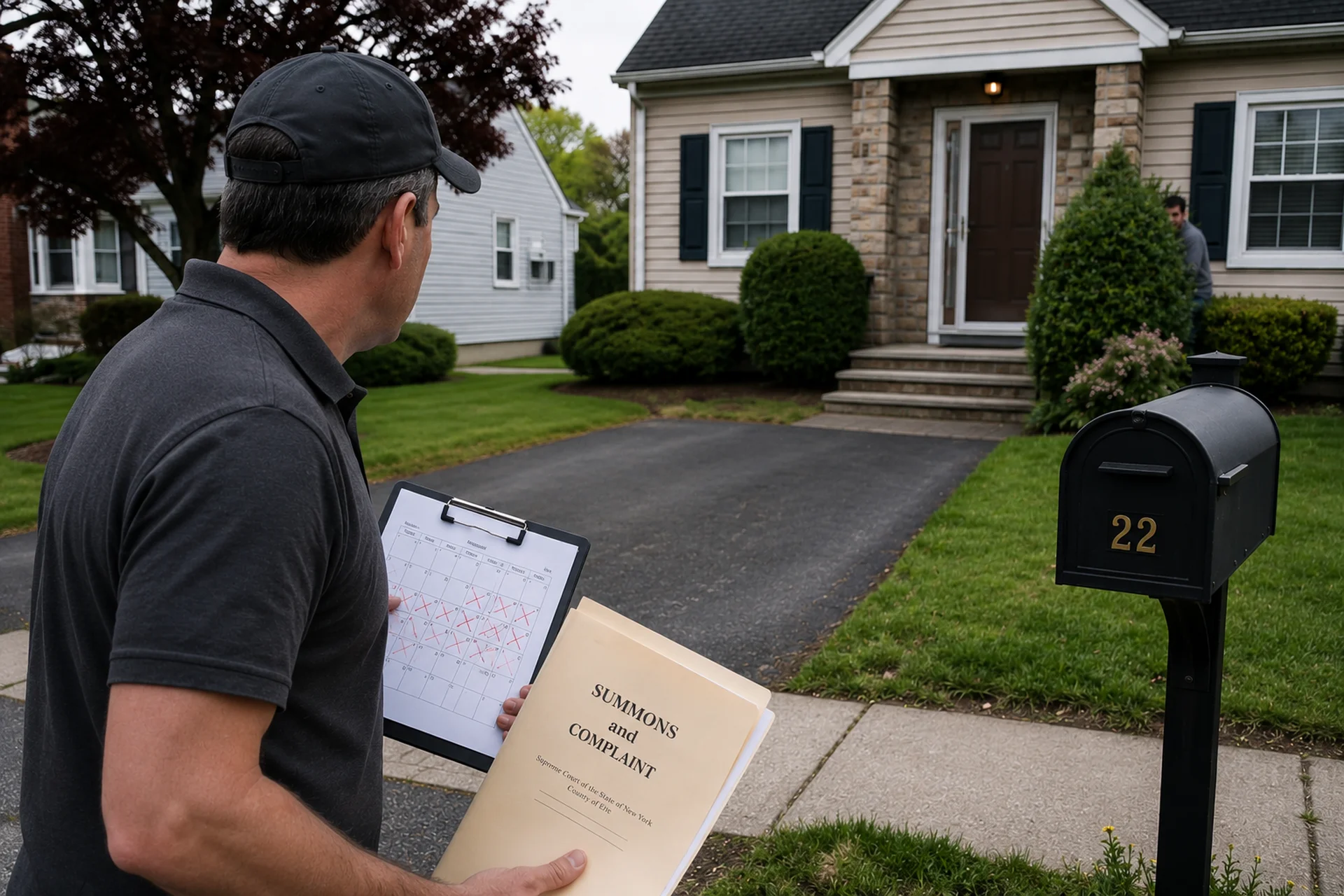
Commencing a personal injury lawsuit is only the first procedural step toward civil recovery. Filing the Summons and Complaint with the court clerk officially begins the action and stops the statute of limitations clock, but it does not notify the defendant, and it does not compel anyone to appear in court. A second, independent countdown starts the moment the papers are filed, and missing this deadline can cause an otherwise valid case to be dismissed before it ever reaches a courtroom. Under New York law, the plaintiff bears the responsibility of formally delivering those papers to the defendant.
In This Article: Serving a Personal Injury Lawsuit in New York
CPLR 306-b: New York’s 120-Day Service Rule for Personal Injury Lawsuits
New York Civil Practice Law and Rules ("CPLR") § 306-b sets three specific requirements governing when and how the Summons and Complaint, the official pleading that names the responsible parties and details the injuries and claims being asserted, must reach each defendant named in the action.
New York recognizes several methods of accomplishing this, including personal delivery directly to the defendant, substitute service on a person of suitable age and discretion at the defendant's home or place of business followed by mailing, and service on an authorized agent. Whichever method is used, the delivery must satisfy the specific procedural requirements that govern that method.
The failure to serve the defendants within the time frame is not always deadly to the case. As long as the case is within the statute of limitations, the Summons & Complaint can be re-filed and then another 120-day window starts. This becomes a problem when the statute of limitations passes and a new Summons & Complaint cannot be filed. This is another example showing the importance of being proactive in filing of papers, especially a Summons & Complaint.
1. The 120-Day General Window to Serve New York Personal Injury Lawsuits
A plaintiff has exactly 120 days from the date the lawsuit is filed with the court clerk to serve every named defendant named in the lawsuit. The clock runs from the date of filing regardless of how difficult service proves to be or how many defendants are named in the complaint. Each defendant must be served within that window.
2. The Shortened 15-Day Exception for Short Limitations Periods
Most personal injury claims are governed by a three-year statute of limitations and fall entirely within the standard 120-day window. The 15-day exception applies only to claims with a limitations period of four months or less. A plaintiff who has filed a Notice of Claim against a municipality and then commenced a lawsuit near the expiration of the applicable one-year-and-ninety-day period, for example, may face a compressed service window that leaves little time to locate and serve the defendant before the deadline arrives. Service must be completed no later than 15 days after the underlying limitations period expires.
3. Proof of Service: The Affidavit of Service in New York Courts
Delivering the papers to the defendant is not enough on its own. The process server must execute a notarized Affidavit of Service confirming that delivery occurred in compliance with New York's recognized methods and file it with the court. Without that sworn record, a plaintiff cannot prove service took place.
Saving an Untimely Personal Injury Case: The "Interest of Justice" Extension
A missed or expiring service deadline is not automatically fatal. CPLR § 306-b grants New York courts the authority to extend the service window when a defendant moves for dismissal or when a plaintiff files a motion seeking additional time before the deadline expires. Courts evaluate those requests under one of two distinct legal standards, depending on the circumstances of the service failure.
Good Cause Shown for Extending the Service Deadline
The first standard requires the plaintiff to demonstrate that continuous, diligent, and reasonable efforts were made to locate and serve the defendant, but that those efforts were derailed by circumstances outside the plaintiff's control. A process server who makes repeated attempts at a defendant's last known address, conducts database searches for updated contact information, and attempts service at a known workplace before the deadline expires has likely built a sufficient record to support a good cause application. A plaintiff who failed to hire a process server promptly, or whose attorney lost track of the deadline, has not. Good cause is the more demanding of the two standards, and courts applying it focus almost entirely on the diligence of the plaintiff's service efforts and the nature of the obstacle that prevented completion.
The "Interest of Justice" Standard for Extending Service Deadlines
The New York State Court of Appeals established a broader equitable safety net for cases that cannot satisfy the good cause requirement. Under the interest of justice standard, courts are not limited to evaluating the plaintiff's diligence. Judges may weigh multiple factors simultaneously, including the legal merit of the underlying injury claim, whether the defendant had actual notice of the lawsuit or the underlying accident through insurance investigators, medical records requests, or other channels, the length of the delay in completing service, and whether a dismissal would deprive the plaintiff of any realistic path to recovery because the limitations period has already expired.
Worried About a Missed Service Deadline? Contact Sternberg Injury Law Firm
Injury victims who are concerned about an approaching or missed service deadline can contact Sternberg Injury Law Firm for a free case evaluation. Insurance companies and defense attorneys look for procedural missteps and will exploit them without mercy to avoid paying compensation. The attorneys at Sternberg Injury Law Firm move quickly to file, locate, and serve defendants, preserving clients' rights to recover compensation for medical bills, lost wages, and pain and suffering.
Frequently Asked Questions About Personal Injury Lawsuit Deadlines in New York
Several options remain available before the window closes. Skip-tracing through DMV records and property databases can surface updated addresses. A court can authorize alternative service under CPLR § 308(5), such as service by email or social media, when conventional methods have been exhausted. The key is identifying the location problem early enough to pursue any of these remedies within the deadline.
Yes, if the statute of limitations period has not yet expired. Refiling starts a new 120-day service window, but time already consumed by the original action does not toll the limitations period. Defendants may also argue that evidence was lost during the gap between actions.
No. The deadline runs independently for each named defendant. Serving some defendants on time does not protect unserved ones, and an extension granted for one defendant does not automatically cover the others.