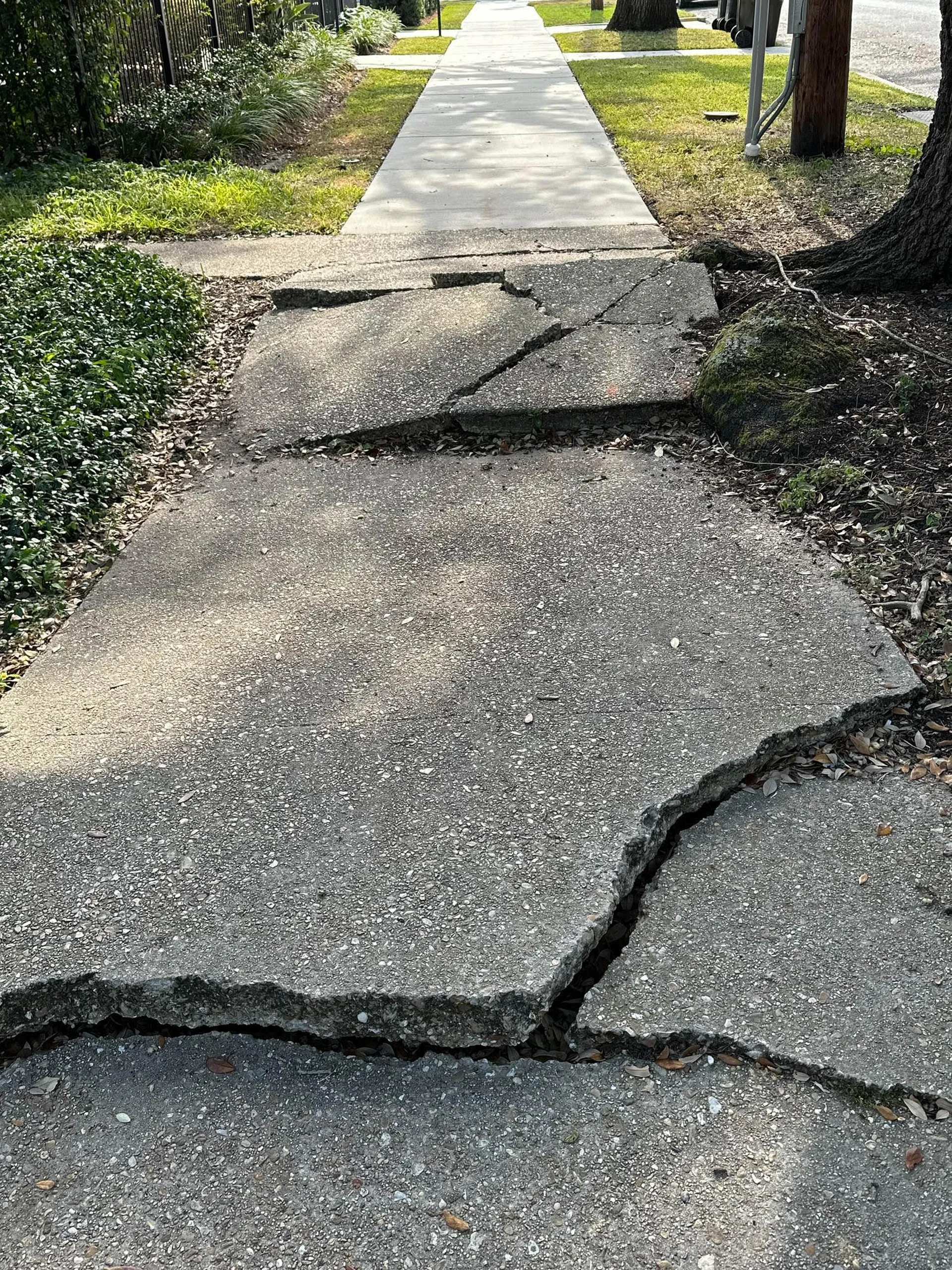
Who Is Liable for a Sidewalk Defect in NYC?
Sidewalk trips and falls are one of the most common injury claims in New York City, but people often misunderstand who is responsible. The widespread assumption that the City of New York is always responsible for sidewalk conditions, simply because sidewalks are public infrastructure, is incorrect in most cases.
Under NYC Administrative Code § 7-210, responsibility for many sidewalk defects shifted from the City to the owner of the property in front of the sidewalk. The law requires that the property owner make sure there is ongoing maintenance and repair, not just a response after someone gets hurt. Broken concrete slabs, uneven surfaces, and sharp height differences between slabs can therefore make the property owner, rather than the City, responsible for your injuries.
Equally important is the nature of that responsibility. Under § 7-210, the property owner's legal duty is non-delegable, meaning it cannot be passed off to someone else. Even if the owner hires a contractor, property manager, or assigns responsibility to a tenant, the legal duty to keep the sidewalk safe stays with the owner.
When someone trips on a broken sidewalk in New York City, the first question is not who owns the sidewalk. It is whether the owner of the property in front of that sidewalk had the legal duty to maintain it under § 7-210, and whether they failed to do so.
What NYC Administrative Code § 7-210 Requires
Enacted as Local Law 49 of 2003, Administrative Code § 7-210 requires owners of property in front of a public sidewalk to keep that sidewalk in a reasonably safe condition. Owners who fail to do so can be held legally responsible for injuries or property damage that result. By shifting this responsibility from the City to neighboring property owners, the law fundamentally changed who gets sued when someone trips on a sidewalk in the five boros.
A covered defect can take many forms. Common examples include cracked or broken concrete slabs, raised or sunken sections, uneven joints, and sharp height differences between slabs. Any condition that creates a tripping or slipping hazard may qualify. Every case depends on its specific facts. Courts also apply what's called the "trivial defect" rule, meaning a defect that is extremely minor may not be enough to support a lawsuit, even if the sidewalk technically falls under § 7-210.
The legal obligation goes beyond fixing problems after someone gets hurt. It includes ongoing upkeep and inspection. An owner who receives a Department of Transportation (DOT) sidewalk inspection notice, watches a condition deteriorate over time, or otherwise knew or should have known about a defect and does nothing, can face significant liability if someone is injured.
What "Non-Delegable Duty" Means in Plain English
A non-delegable duty means the property owner cannot hand off the legal responsibility to someone else, even if they hire someone else to do the actual work. Under § 7-210, the owner of the property next to the sidewalk cannot escape liability by showing that a tenant, snow removal contractor, masonry company, or property manager was responsible for sidewalk maintenance under a contract or lease.
An owner may have a lease or contract that requires another party to handle repairs or cover costs. Those rights may still be enforceable between the owner and that other party. But they do not affect the injured person's right to hold the property owner directly responsible under § 7-210.
New York's highest court confirmed this in Xiang Fu He v. Troon Management, holding that § 7-210 unambiguously places this non-transferable responsibility on covered property owners. That decision is discussed further in the case law section below.
- Who pays the injured person: usually the property owner in front of the sidewalk.
- Who ultimately covers the cost between owner and contractor: can be sorted out separately through contracts or legal claims between those parties.
When the One-, Two-, or Three-Family Home Exception Applies
Section 7-210 does not apply the same way to every property. The law contains an important exception for owner-occupied one-, two-, or three-family homes used exclusively as a residence.
All three conditions must be met. The owner must live in the home. It must be a one-, two-, or three-family property. And it must be used only as a home, not for any business purpose. A property with any commercial use, one where the owner does not live, or one that doesn't otherwise meet all three criteria does not qualify for this exception.
When the exception applies, the City of New York may be responsible instead. However, suing the City comes with extra steps that don't apply to claims against private owners. Under NYC Charter § 7-201(c), the City must have previously received official written notice of the specific defect. This is a hard requirement before you can sue. You must also file a formal Notice of Claim under General Municipal Law § 50-e, typically within 90 days of the accident. These extra requirements make claims against the City very different from claims against a private property owner under § 7-210.
2026 NYC Sidewalk Enforcement Update: Introduction 0195-2026
In 2026, the New York City Council introduced Introduction 0195-2026, a bill that would increase fines against property owners who ignore Department of Transportation (DOT) orders to fix their sidewalks. As of this writing, it is still a proposed bill, not yet law, and it shows that City lawmakers are pushing owners harder to fix sidewalk problems quickly.
The proposal would add extra fines for failing to complete repairs after a DOT order, and for ignoring a sidewalk condition that is immediately dangerous after being notified. If passed, property owners who drag their feet on repairs would face financial penalties on top of any lawsuit from an injured person.
Whether or not the bill becomes law, it reflects the direction things are heading. Sidewalk upkeep is getting more enforcement attention. In a lawsuit, records showing the owner received DOT notices but delayed repairs can be powerful evidence that the owner knew about the problem and failed to act reasonably.
- Higher fines for ignoring DOT repair orders.
- Extra penalties for leaving a dangerous defect unaddressed after being notified.
- Stronger evidence against them in a lawsuit, since a paper trail of DOT notices and delayed repairs shows the owner knew about the problem and chose not to fix it.
Key Cases Interpreting NYC Sidewalk Liability
The law sets the rules, but court decisions show how those rules play out in real disputes. Three rulings from New York's highest court, the Court of Appeals, are particularly important to understand.
Vucetovic v. Epsom Downs, Inc.
In Vucetovic v. Epsom Downs, the Court of Appeals ruled that a tree pit next to the sidewalk is not considered a "sidewalk" under § 7-210. That means the neighboring property owner has no § 7-210 responsibility for conditions inside a tree pit.
The case established an important first question in any sidewalk injury claim: courts must first decide whether the hazardous condition is actually part of the sidewalk as the defined by law. Features alongside the walking surface, like tree pits, curbs, or other structures, may fall outside the law's coverage. If the condition does fall within the law, a separate analysis under the "trivial defect" rule then determines whether the defect is serious enough to support a lawsuit.
Sangaray v. West River Associates
Sangaray v. West River Associates addressed what happens when a broken sidewalk slab sits right on the border between two properties, or when there is a dispute about which property the defect is next to. The Court of Appeals ruled that each property owner is responsible for the sidewalk in front of their own property, and being close to a property line boundary doesn't get an owner off the hook if their neglect contributed to the hazardous condition.
Responsibility under § 7-210 isn't determined by figuring out which exact inch of concrete someone's foot hit. What matters is whether the defect was in front of the owner's property and whether the owner's failure to fix it caused the accident.
Xiang Fu He v. Troon Management, Inc.
In Xiang Fu He v. Troon Management, the Court of Appeals ruled that the responsibility under § 7-210 cannot be passed off to someone else. A property owner cannot get out of a lawsuit by showing that a lease, property management agreement, or service contract put sidewalk maintenance on a third party.
The owner may be able to seek reimbursement from whoever was contractually supposed to handle the maintenance, but that is a separate dispute between them. It doesn't affect the injured person's right to hold the property owner directly responsible under the law.
Example of Liability for a Raised Sidewalk Flag
A pedestrian walks past a mixed-use building in Queens and trips on a raised sidewalk slab with a noticeable height difference. The City's Department of Transportation had issued a sidewalk inspection notice months earlier. The owner hired a masonry contractor, but the repair was never completed before the accident.
Under § 7-210, the owner of the property next to the sidewalk is the first party whose responsibility gets examined. The defective condition, a cracked, raised concrete slab, is not an excluded structure like a tree pit, so it clearly falls under the law. That the owner knew about the problem is shown by the DOT inspection record, how long the defect was visible, and any photos or witness accounts of its condition over time.
The rule that responsibility cannot be passed off blocks the owner from shifting all the blame to the contractor. The owner remains directly responsible to the injured person regardless of whatever agreement they had with the contractor. Any reimbursement claim the owner has against the contractor is a separate issue that does not affect the injured person's right to pursue their case against the owner.
Common Myths About NYC Sidewalk Liability
What Injured Pedestrians Must Prove in a Sidewalk Liability Claim
If you were injured in a sidewalk fall, the first step is figuring out who is responsible, and therefore who should be investigated and potentially sued. A § 7-210 claim requires proof of a defect covered by the law, that the right party knew or should have known about it, and that it directly caused your injury. The defect also must be significant enough to matter legally. Courts look at photos, measurements, and the specific circumstances of the fall.
Identifying the right party early is important both for building a strong case and for meeting legal deadlines. In a § 7-210 case, that means identifying the property owner next to the sidewalk, checking whether the residential exception applies, and preserving evidence, such as DOT inspection records, prior violation notices, repair photos, and any information about how long the defect existed. If the residential exception applies and the City is responsible instead, the strict prior written notice requirements of NYC Charter § 7-201(c) and General Municipal Law § 50-e must be met.
These cases also involve broader personal injury issues, including whether you share any fault under CPLR 1411, what caused the fall, and what damages were suffered. But the foundational question is always: who had the legal duty to maintain that sidewalk, and did their failure cause the accident?
Key Takeaways on NYC Sidewalk Liability
Administrative Code § 7-210 puts the responsibility to maintain public sidewalks on property owners whose land borders those sidewalks, not the City of New York. That responsibility cannot be transferred: hiring someone else to do the maintenance doesn't remove the owner's direct legal liability to an injured person. The exception for owner-occupied 1–3 family homes narrows, but does not eliminate, this framework. When it applies and the City is responsible instead, separate requirements apply, including prior written notice to the City under NYC Charter § 7-201(c).
Introduction 0195-2026, if passed, would add extra fines for owners who ignore DOT repair orders, reinforcing a clear trend toward stricter sidewalk enforcement in New York City.
If you were injured in a sidewalk fall in New York City, you can contact the Sternberg Law Firm to discuss how these rules may apply to your specific situation.
NYC Sidewalk Liability FAQ
Under Administrative Code § 7-210, enacted as Local Law 49 of 2003, the owner of the property in front of a public sidewalk is responsible for keeping that sidewalk in a reasonably safe condition. If they fail to do so and someone is injured, the property owner can be held legally responsible. A limited exception applies to owner-occupied one-, two-, or three-family homes used only as a residence.
It means the property owner cannot escape legal responsibility by pointing to a contract that assigns the work to someone else. Under § 7-210, the owner can't get out of their duty to an injured person by having a tenant, property manager, or contractor handle the sidewalk maintenance. New York's Court of Appeals confirmed this in Xiang Fu He v. Troon Management, Inc., 34 NY3d 167 (2019).
No. Having a maintenance contract doesn't eliminate the owner's legal responsibility to the injured person. The owner may have a separate claim against the contractor to recover costs, but that's a dispute between them. It doesn't affect the injured person's right to hold the property owner directly responsible under § 7-210.
The law does not hold an owner responsible under § 7-210 if they live in the home themselves and it is a one-, two-, or three-family property used only as a residence. All three conditions must apply: the owner must live there, it must be a 1–3 family home, and it must be used only as a home. When the exception applies and the City is responsible instead, the injured person must meet the prior written notice requirement under NYC Charter § 7-201(c) and file a formal Notice of Claim under General Municipal Law § 50-e.
Introduction 0195-2026 is a pending New York City Council bill that would increase fines for property owners who ignore DOT sidewalk repair orders or fail to address a dangerous defect after being notified. It hasn't passed yet, but it shows the clear direction toward stricter sidewalk enforcement. In a lawsuit, records of DOT notices and delayed repairs can be powerful evidence that the owner knew about the problem and failed to act.