Different Rules for Injury Claims Against Government Entities
Personal injury claims against government entities in New York State operate under a different set of rules than claims against private parties. Before a lawsuit can be filed, an injured person must satisfy specific procedural prerequisites. Once those prerequisites are met, the window to commence an action is shorter than it would be for most private-party claims. Missing any one of these requirements can invalidate an otherwise legitimate claim.
In This Article
Suing Government Entities in New York for Personal Injury
New York law preserves the right of injured people to seek compensation from governmental entities whose negligence caused harm, but that right comes with conditions that do not apply to private defendants. Under CPLR § 217-a, qualifying entities include political subdivisions of the state, such as cities, counties, towns, and villages; agencies and instrumentalities of the state or its political subdivisions, such as the New York City Department of Transportation; public authorities, such as the Metropolitan Transportation Authority and the Port Authority of New York and New Jersey; and public benefit corporations that are entitled to receive a notice of claim as a condition precedent to suit.
Correctly identifying which governmental entity is responsible for the injury is the necessary first step. The applicable rules and procedures may differ depending on which entity is named, and serving the wrong respondent can forfeit the claim.
Statute of Limitations for Injuries Caused by Government Entities
Most personal injury actions governed by CPLR § 217-a must commence within one year and ninety days from the date the cause of action accrues, which is generally the date of the injury. That period is shorter than the three-year statute of limitations that applies to most personal injury claims against private parties.
Wrongful death claims against governmental entities are not governed by the one year and ninety-day limitation. They instead follow the separate limitations period applicable to wrongful death actions under the Estates, Powers and Trusts Law.
Notice of Claim
Serving a Notice of Claim on the responsible governmental entity is, in most cases, a mandatory condition precedent to commencing a lawsuit. General Municipal Law § 50-e governs this requirement and mandates that the notice be served within 90 days of the date the claim arises.
A court may, in its discretion, grant leave to serve a late notice of claim. The key factors a court considers include whether the governmental entity acquired knowledge of the essential facts constituting the claim within 90 days or within a reasonable time thereafter, whether the plaintiff had a reasonable excuse for the delay, and whether the delay would substantially prejudice the entity in maintaining its defense. Leave to serve a late notice is not guaranteed, and relying on the possibility of judicial relief is not a substitute for timely action.
Common Injury Claims Where Government Entities Are Involved
Government entities own, operate, and maintain a substantial portion of the infrastructure and services that New Yorkers interact with daily. A wide range of accidents can therefore give rise to claims subject to the requirements described above.
Sidewalk and Slip-and-Fall Accidents on City Property
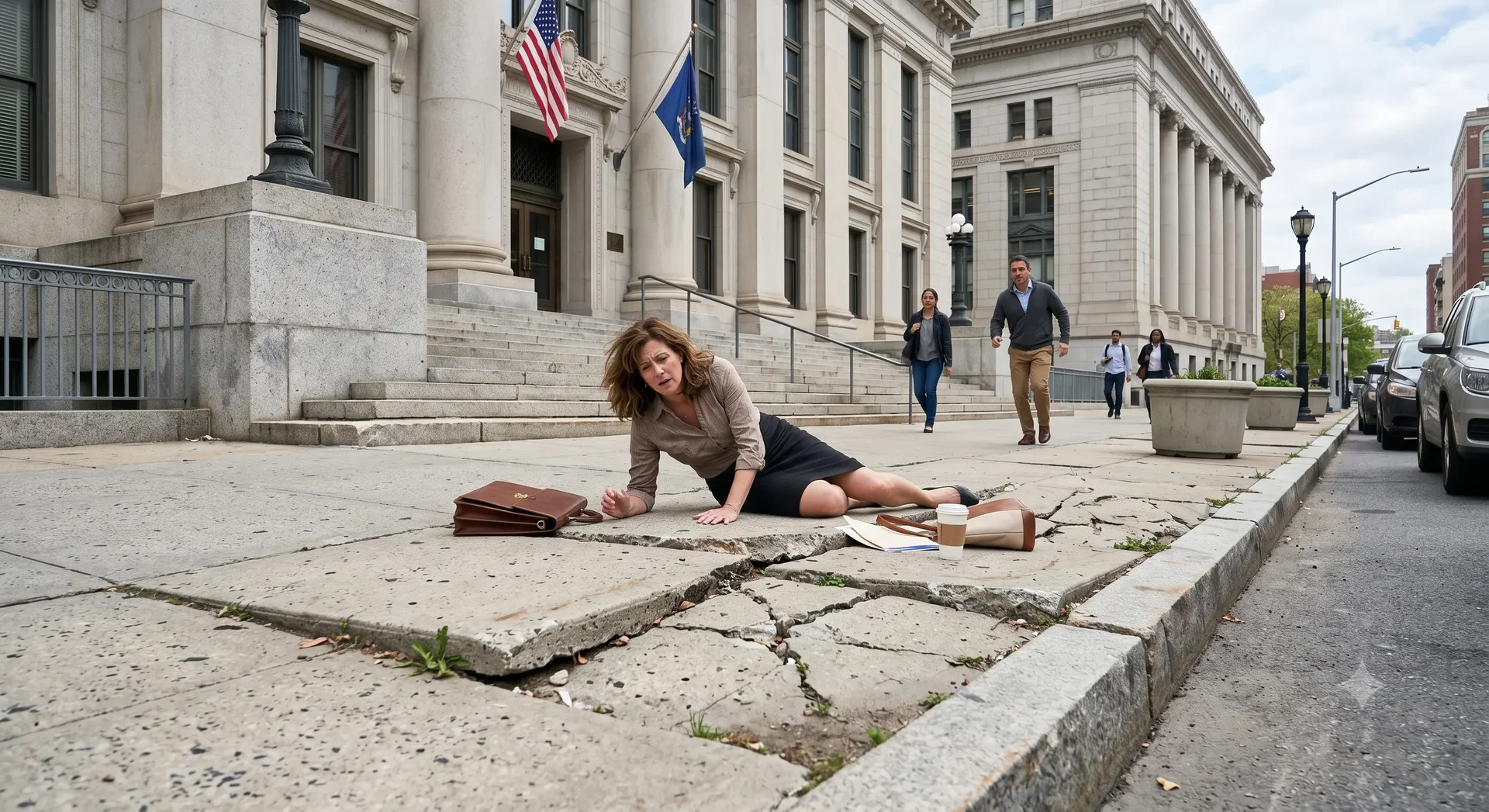
New York City and other municipalities are responsible for maintaining streets, public sidewalks, parks, and government-owned buildings in a reasonably safe condition. Trip-and-fall accidents caused by broken sidewalks, defective curbs, icy walkways, or poorly maintained staircases on city property can give rise to claims against the relevant municipality. The City of New York has also enacted prior written notice requirements for many sidewalk defect claims, meaning a plaintiff may need to establish that the city had actual notice of the dangerous condition before the injury occurred in addition to satisfying the procedural prerequisites that apply to all government entity claims.
MTA and Transit Accidents
The Metropolitan Transportation Authority is a public authority, not a city agency, and claims arising from accidents on train platforms, bus stops, or MTA-operated vehicles are governed by rules specific to the MTA and its subsidiary entities, such as New York City Transit. The MTA and its subsidiaries are public authorities entitled to receive a notice of claim. Injury victims must identify the correct MTA entity, whether the MTA itself, NYCT, MTA Bus, or another subsidiary, before serving their notice, because serving the wrong entity can defeat the claim. The most common accidents in this context include platform falls, train door injuries, and bus accidents.
Motor Vehicle Accidents Involving Government Vehicles
Accidents caused by the negligent operation of city-owned or state-owned vehicles, including sanitation trucks, police cars, fire trucks, and municipal maintenance vehicles, can give rise to personal injury claims against the employing governmental entity. These claims are subject to the same notice of claim requirements as other qualifying government entity claims. Identifying the correct agency and its insurance carrier early in the process is essential to building an effective case.
Dangerous Conditions on Public Roads and Highways
The New York State Department of Transportation, the New York City Department of Transportation, and county and town highway departments are responsible for maintaining the roads, bridges, and highway infrastructure under their respective jurisdictions. Claims arising from pothole damage, failure to post adequate signage, defective guardrails, and improperly maintained traffic signals are commonly asserted against these entities. As with sidewalk claims, certain road defect claims require proof of prior written notice to the agency that is responsible before liability can be established.
Injuries at Public Schools and Government Buildings
Accidents occurring on the premises of public schools, courthouses, government office buildings, or other publicly owned facilities can give rise to personal injury claims against the owning entity or operating entity. Such claims typically involve dangerous conditions on the premises, inadequate security, or negligent supervision. The applicable governmental entity may vary depending on whether the building is owned by a city, a state agency, or a public authority, which is why identifying the correct respondent at the outset carries the same importance here as in every other category of government entity claim.
Sternberg Injury Law Firm PC
Anyone in New York who has been injured due to the negligence of a government entity can contact the Sternberg Injury Law Firm for a free case evaluation. The personal injury attorneys at Sternberg Injury Law Firm understand the procedural traps that can bar valid claims against governmental entities, and move quickly to identify the correct respondent, serve timely notices of claim, and build the strongest possible case on behalf of injured clients. Our firm handles cases on a contingency fee basis, meaning you pay nothing unless the firm recovers compensation for your medical bills, lost wages, and pain and suffering. Anyone who may have a claim against a government entity should act immediately.
Frequently Asked Questions About Personal Injury Claims Against Government Entities in New York
Yes, but resolving the ownership dispute or maintenance dispute is critical because it determines which entity must receive the notice of claim and which procedural rules govern the action. An attorney can investigate ownership records, maintenance agreements, and interagency contracts to identify the correct respondent and ensure that every potentially liable entity is properly notified within the applicable deadlines.
New York courts recognize that infancy and mental incapacity can be relevant factors when a court evaluates a motion for leave to serve a late notice of claim. While neither circumstance automatically extends the 90-day window, a court may consider whether the claimant's condition contributed to the delay and whether the governmental entity was prejudiced as a result. Because these applications are discretionary, early legal consultation is essential.
Potentially, yes. When a private contractor causes injury while working under a government contract, claims may be asserted against both the contractor under standard negligence principles and the governmental entity if its own acts or omissions contributed to the harm. Because the contractor is a private party, the notice of claim requirements do not apply to that portion of the claim, but they remain a condition to any action against the governmental entity.